
When IT Goes Dark, Grocery Shelves Feel the Impact: The Hidden Cyber Risks in Retail Supply Chains
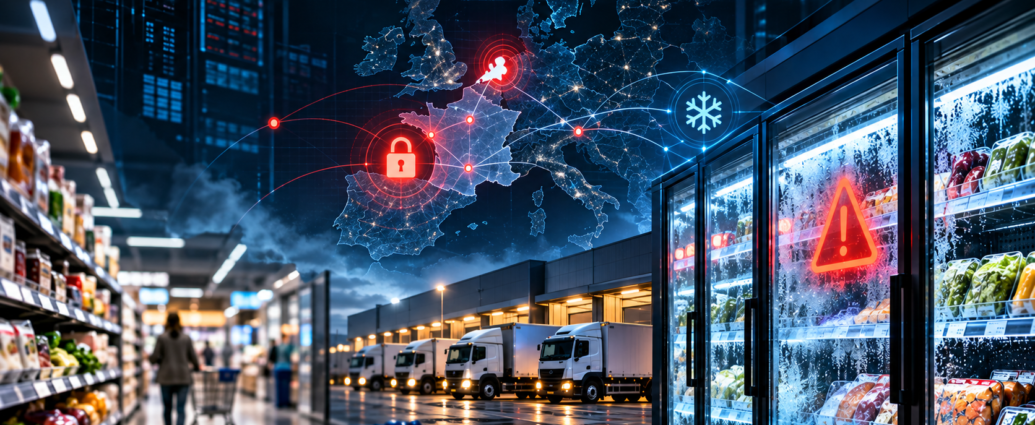
From disrupted supermarket deliveries in the Netherlands to refrigeration cyberattacks in France, two separate incidents reveal why cybersecurity has become a business-continuity priority for the global retail and FMCG industry.
By Emergent Industry Lens | Retail, FMCG & Digital Transformation | October 2026
A supermarket’s technology problem can become a supply chain crisis
When a supermarket’s website goes offline, the immediate assumption is that customers cannot place orders. But what happens when a technology disruption affects the systems that manage inventory, warehouse operations and deliveries? And what happens when a cyber incident targets the equipment responsible for keeping food fresh?
These questions came into focus in October 2026, when two separate incidents highlighted different vulnerabilities in Europe’s grocery retail sector.
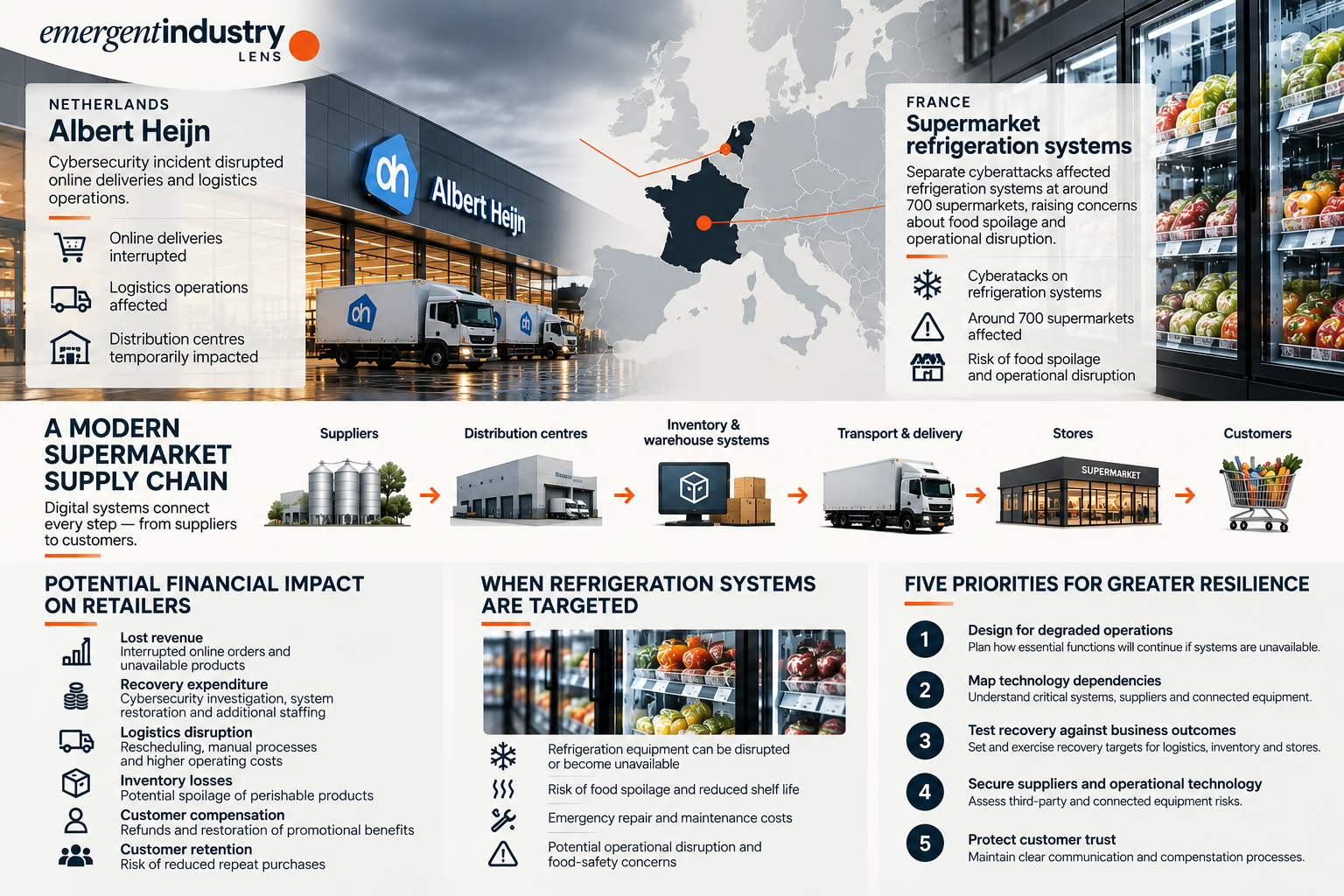
In the Netherlands, Albert Heijn, one of the country’s leading supermarket chains and part of international retail group Ahold Delhaize, experienced a cybersecurity incident that disrupted online shopping and logistics operations.
Beginning on 11 October, the company temporarily disabled parts of its IT environment as a precaution. Physical stores remained open and checkout systems continued to function, but online grocery deliveries were interrupted and distribution operations were affected.
According to Reuters reporting on 14 October, the company expected its distribution centres to resume operations shortly. On 15 October, Albert Heijn confirmed that regular deliveries of fresh and ambient products to stores had resumed across the Netherlands, although availability could still vary by location.
Meanwhile, separate cyberattacks affecting supermarket refrigeration systems in France raised concerns about disruption to temperature-controlled equipment and potential food spoilage. An Associated Press report reported that approximately 700 supermarkets had experienced issues.
The Dutch and French incidents were separate, with no confirmed evidence linking them.
Yet both point to the same strategic challenge. Modern grocery retail depends on digital systems not only to sell products, but also to move, store and preserve them.
When those systems fail, the consequences can extend from technology operations to revenue, inventory, food safety and customer trust.
How does an IT outage disrupt a supermarket supply chain?
A supermarket supply chain is a coordinated flow of products and information.
Manufacturers and suppliers produce goods and deliver them to distribution centres. Inventory systems help determine what each store needs. Warehouse management systems support order allocation, picking and packing. Transport systems coordinate deliveries. Stores receive products and replenish their shelves.
Digital systems connect these activities.
Consider a simple example: a store needs additional milk. Inventory and replenishment systems help determine the required quantity. Warehouse systems support the picking process, while transport planning coordinates delivery.
The physical product travels by truck. The information telling the business what to move, where to send it and when to deliver it travels through digital systems.
If a critical system becomes unavailable, the products may still exist in the warehouse. Trucks and employees may still be available. But the retailer may struggle to coordinate those resources efficiently.
A warehouse system outage, for example, could delay order processing, dispatch and store deliveries. If replenishment is delayed long enough, stores may run short of particular products, customers may buy elsewhere and fresh goods may lose valuable selling time.
This is the distinction between physical capacity and digital coordination capacity.
A retailer can possess stock, vehicles, warehouses and staff yet still struggle to move goods when the information systems coordinating those resources are unavailable.
In Albert Heijn’s case, the company’s own updates confirmed that the incident affected logistics operations and interrupted online deliveries. The hypothetical sequence above explains the broader supply-chain mechanism; it should not be interpreted as confirmation that every stage was affected in precisely that way.
The lesson for retail executives: a cybersecurity incident can become a physical supply-chain disruption when the systems coordinating the movement of goods become unavailable.
Two incidents, two different types of retail risk
The Albert Heijn incident and the French refrigeration attacks illustrate different ways technology failures can affect grocery operations.
1. When logistics systems stop coordinating deliveries
Albert Heijn’s disruption demonstrated the dependence of grocery distribution on digital infrastructure.
The immediate effects included interrupted online deliveries and disruption to logistics operations. The company subsequently confirmed that regular store deliveries had resumed by 15 October, although product availability could still vary.
The potential business consequences extend beyond the online channel. If store replenishment is delayed, retailers may miss sales opportunities, incur additional operating costs and face difficulties coordinating suppliers and distribution schedules.
The extent of any such financial losses at Albert Heijn has not been publicly quantified.
2. When refrigeration technology becomes a cyber risk
The French incidents highlighted a different vulnerability. Connected systems that control physical retail infrastructure.
According to the Associated Press report, approximately 700 supermarkets experienced issues involving refrigeration systems.
Refrigeration is a critical operational function in grocery retail. Chilled and frozen products depend on controlled temperatures throughout storage and display. If refrigeration equipment fails or cannot be managed reliably, retailers may face inventory losses, emergency maintenance requirements and potential food-safety concerns.
Cybersecurity risks involving connected equipment therefore have implications beyond data protection. They can affect the physical conditions required to preserve products.
It is important not to overstate the evidence. The French incidents were separate from Albert Heijn’s disruption, and the reported figure of approximately 700 supermarkets should not be interpreted as meaning every affected store suffered food spoilage.
Nevertheless, the broader lesson is clear. A cyber incident affecting logistics technology can interrupt the movement of products; an incident affecting refrigeration controls can threaten the conditions in which products are stored.
Both are operational resilience issues.
What is the potential financial impact on retailers?
Neither the Albert Heijn incident nor the wider sector examples should be assigned an unverified financial-loss figure. The financial consequences depend on the systems affected, the duration of disruption, the products involved and how effectively the retailer maintains alternative operations.
For a supermarket, the main areas of potential financial exposure include:
| Financial exposure | How costs may arise |
|---|---|
| Lost revenue | Interrupted online orders, unavailable products and customers switching retailers |
| Recovery expenditure | Cybersecurity investigations, system restoration, specialist support and additional staffing |
| Logistics disruption | Delayed deliveries, rescheduling, manual processes and coordination costs |
| Inventory losses | Potential spoilage or reduced selling time for perishable products |
| Customer compensation | Refunds, replacement orders and restoration of affected promotional benefits |
| Customer retention | Potential loss of repeat purchases if service reliability or trust deteriorates |
What do we know about Albert Heijn’s financial losses?
As of 15 October 2026, Albert Heijn and its parent company, Ahold Delhaize, had not publicly disclosed a specific monetary estimate of losses attributable to the incident.
The confirmed operational disruption identifies where financial exposure may arise, but it does not establish the value of lost sales, additional costs or any lasting customer impact.
Albert Heijn said affected customers would be compensated for unavailable personalised discounts where possible. Its 15 October update also confirmed that regular deliveries of fresh and ambient products had resumed, while availability could still vary between stores.
These developments help establish the operational timeline, but they are not a financial-loss statement.
Ahold Delhaize scheduled its third-quarter 2026 results for 4 November 2026. Those results may provide further context on trading performance, although the company is not guaranteed to disclose incident-specific losses.
For retailers, the important point is that the financial cost of a cyber incident is not necessarily limited to repairing IT systems. It may also involve lost transactions, additional logistics expenditure, customer compensation and inventory risks.
The French refrigeration incidents illustrate a separate potential exposure: when connected equipment fails to preserve products, the consequences can extend to physical inventory and food-safety management.
Why grocery retail is particularly vulnerable
Perishable products leave little room for delay
Fresh produce, dairy, meat, fish and frozen foods have specific storage and shelf-life requirements.
A delivery delay can reduce the time available to sell a product. A refrigeration problem can create additional concerns about quality, temperature control and whether products remain suitable for sale.
Retail continuity planning must therefore consider product integrity, not merely the availability of software and networks.
Customers can switch retailers quickly
Groceries are purchased frequently, and customers have alternatives.
If an online order cannot be placed or essential products are unavailable, shoppers may visit another supermarket or use a different delivery service. Some customers may return once normal operations resume, but any lasting effect on purchasing behaviour depends on the circumstances.
The potential commercial exposure is straightforward: an unavailable shopping channel or an empty shelf can mean a lost transaction.
Digital systems create interconnected dependencies
Inventory management, warehouse operations, transport planning, pricing and loyalty platforms frequently exchange information.
This integration improves efficiency under normal conditions. However, shared infrastructure and third-party services can create dependencies across multiple business functions.
A retailer may discover that several apparently separate operations depend on the same underlying platform only when that platform becomes unavailable.
The objective is not to eliminate integration. It is to understand these dependencies and ensure that critical operations have workable recovery options.
Connected equipment expands the risk landscape
Refrigeration controls, building management systems, warehouse automation and remote maintenance tools can connect physical operations to wider digital environments.
These technologies can improve efficiency, monitoring and energy management. But they also need appropriate security controls, access management, monitoring and recovery procedures.
The French incidents reinforce the importance of including operational technology in cybersecurity planning rather than treating it as separate from enterprise IT risk.
What does the wider cybersecurity research tell us?
The incidents reflect a broader challenge for organisations that rely on interconnected systems and external technology providers.
The European Union Agency for Cybersecurity (ENISA), in its NIS Investments 2025 report, reported that 47% of surveyed organisations identified supply-chain and third-party attacks as a leading future concern.
The report also found that organisations continued to face challenges in areas including patching, business continuity and supply-chain risk management.
These are cross-sector findings, not statistics specific to supermarket retailers. However, they are relevant to grocery businesses whose operations depend on technology vendors, cloud services, logistics platforms, connected equipment and third-party maintenance providers.
A retailer can have security controls in place and still experience disruption. Cybersecurity reduces risk; business continuity determines how essential operations are maintained or restored when prevention fails.
Five priorities for retailers and FMCG companies
1. Design for degraded operations
Business continuity plans should specify how essential functions will operate when central systems are unavailable.
Depending on the business, this may involve alternative order-processing arrangements, manual dispatch procedures, prioritisation of essential products, store-level inventory checks and agreed communication methods for logistics partners.
For refrigeration and other critical operational technology, plans should also cover safe monitoring, escalation and recovery if connected controls become unavailable.
Manual procedures are not a complete substitute for digital systems. They are temporary mechanisms for protecting essential operations while recovery takes place.
2. Map technology dependencies across the supply chain
Retailers should understand which applications, providers and connected devices support each critical business process.
This includes identifying shared cloud infrastructure, identity services, warehouse platforms, external service providers and operational technology dependencies.
Businesses should determine which operations can function independently, which require external support and how long essential functions can continue without normal systems.
3. Test recovery against business outcomes
Restoring an application does not automatically mean that the supply chain has recovered.
Retailers should establish and test recovery targets for critical services, including:
- Recovery time objective (RTO): how quickly a critical service must be restored.
- Recovery point objective (RPO): how much data loss, measured in time, is acceptable.
- Store replenishment recovery: how quickly reliable deliveries can resume.
- Order fulfilment recovery: how quickly online orders can be processed and delivered.
- Inventory reconciliation: how quickly accurate stock records can be re-established.
- Operational technology recovery: how quickly critical equipment can be restored safely.
Recovery exercises should involve IT, logistics, store operations, procurement, facilities teams, suppliers and communications staff.
4. Treat supplier and operational technology security as business risks
Retailers should assess the security and recovery capabilities of critical technology providers, not simply rely on contractual assurances.
Reviews should cover remote access, incident notification, backup arrangements, service dependencies and concentration risk.
For connected equipment, businesses should understand who can access control systems remotely, how access is monitored and what happens if normal connectivity or management tools become unavailable.
FMCG manufacturers and logistics partners should also agree on how orders, delivery schedules and inventory information will be handled during an outage.
5. Protect customer trust during disruption
Customer communication is part of business continuity.
Retailers need reliable ways to explain cancelled orders, refunds, delayed deliveries, product availability and pricing issues. Alternative communication channels should be available if the website, mobile application and customer service systems become unavailable together.
Clear communication and appropriate compensation can reduce uncertainty, even when normal operations cannot immediately resume.
Why FMCG manufacturers and logistics providers must prepare too
A retailer’s technology outage can create uncertainty upstream as well as downstream.
Manufacturers depend on purchase orders, forecasts, delivery schedules and inventory signals from retail customers. If those signals become unavailable or unreliable, manufacturers may struggle to determine which goods to dispatch and when.
Logistics providers may face cancelled collections, revised delivery windows and incomplete instructions. Suppliers may send products that a retailer cannot receive or process according to the original schedule.
The consequences can extend beyond the retailer experiencing the incident. Other organisations may have to adjust production plans, warehouse capacity, transport schedules and inventory decisions.
FMCG manufacturers and logistics providers should therefore establish alternative communication channels, agree on priorities for essential products and test how orders and inventory records will be reconciled after recovery.
The objective is to prevent an isolated technology incident from becoming a wider breakdown in coordination across the supply network.
The strategic shift: From cybersecurity to operational resilience
The Albert Heijn incident does not demonstrate that digital integration is inherently unsafe. Integrated technology remains essential to modern retail, enabling forecasting, efficient distribution, inventory visibility and convenient customer experiences.
The separate French refrigeration incidents add another dimension: connected technology can also influence the physical conditions in which goods are stored and preserved.
The challenge is to combine digital efficiency with the ability to withstand disruption.
For executive teams, the questions should extend beyond whether systems are secure:
- Which products and services must remain available during an outage?
- How long can distribution centres operate without their normal systems?
- Can stores receive essential products through alternative procedures?
- How will refrigeration and other critical equipment be monitored if connected controls fail?
- Which external technology dependencies could interrupt multiple business functions?
- How quickly can reliable inventory, delivery and equipment information be restored?
The answers determine whether a business can preserve essential operations while its technology environment is being recovered.
The competitive advantage will belong to retailers that can recover operationally, not merely restore technology.
Frequently asked questions
How can a cyberattack disrupt a retail supply chain?
A cyberattack can make inventory, warehouse management, order-processing or transport systems unavailable. This can delay product picking, dispatch and delivery, affecting store replenishment even when physical stock and vehicles remain available.
How can a cyberattack affect supermarket refrigeration?
If connected refrigeration systems or their control mechanisms are compromised or become unavailable, stores may face equipment disruption, temperature-control concerns, emergency repair costs and potential food spoilage. The actual impact depends on the equipment affected and the effectiveness of safety and recovery procedures.
Were the Albert Heijn and French refrigeration incidents connected?
There was no confirmed evidence linking the Dutch Albert Heijn incident with the separate French supermarket refrigeration attacks. They should be treated as distinct incidents that illustrate different categories of retail cyber risk.
What is the difference between cybersecurity and supply-chain resilience?
Cybersecurity helps protect systems, data and infrastructure from threats. Supply-chain resilience is the ability to maintain or recover essential product flows and business operations during disruptions. Cybersecurity is one component of a broader resilience strategy that includes contingency procedures, supplier coordination and recovery testing.
What can FMCG manufacturers learn from these incidents?
Manufacturers should prepare for situations in which retail customers cannot process orders or confirm delivery schedules normally. Alternative communication channels, agreed dispatch priorities and procedures for reconciling orders after recovery can reduce the operational impact.
What was the financial impact on Albert Heijn?
As of 15 October 2026, Albert Heijn and Ahold Delhaize had not publicly disclosed a specific monetary estimate of losses from the incident. Potential exposure includes lost online sales, recovery expenditure, customer compensation and additional logistics costs. These are possible impacts, not confirmed financial losses.
Editorial note: The Albert Heijn and French refrigeration incidents are separate events. Company statements and news reports support the incident timelines; the financial exposures and operational recommendations discussed here are analysis, not estimates of confirmed losses.
Want to be published on our website? Contact us