
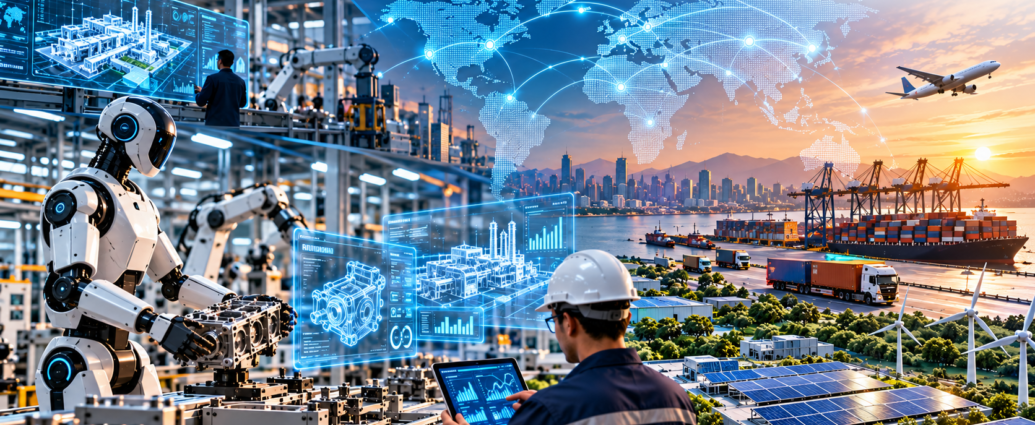
From agentic AI and physical robots to adaptive production systems and intelligent supply chains, global manufacturing is approaching a new phase of industrial transformation. In 2027, competitive advantage will increasingly depend on how effectively manufacturers connect technology, people, data and operations to deliver measurable business outcomes.
Explora Industry Lens | Manufacturing & Industrial Innovation
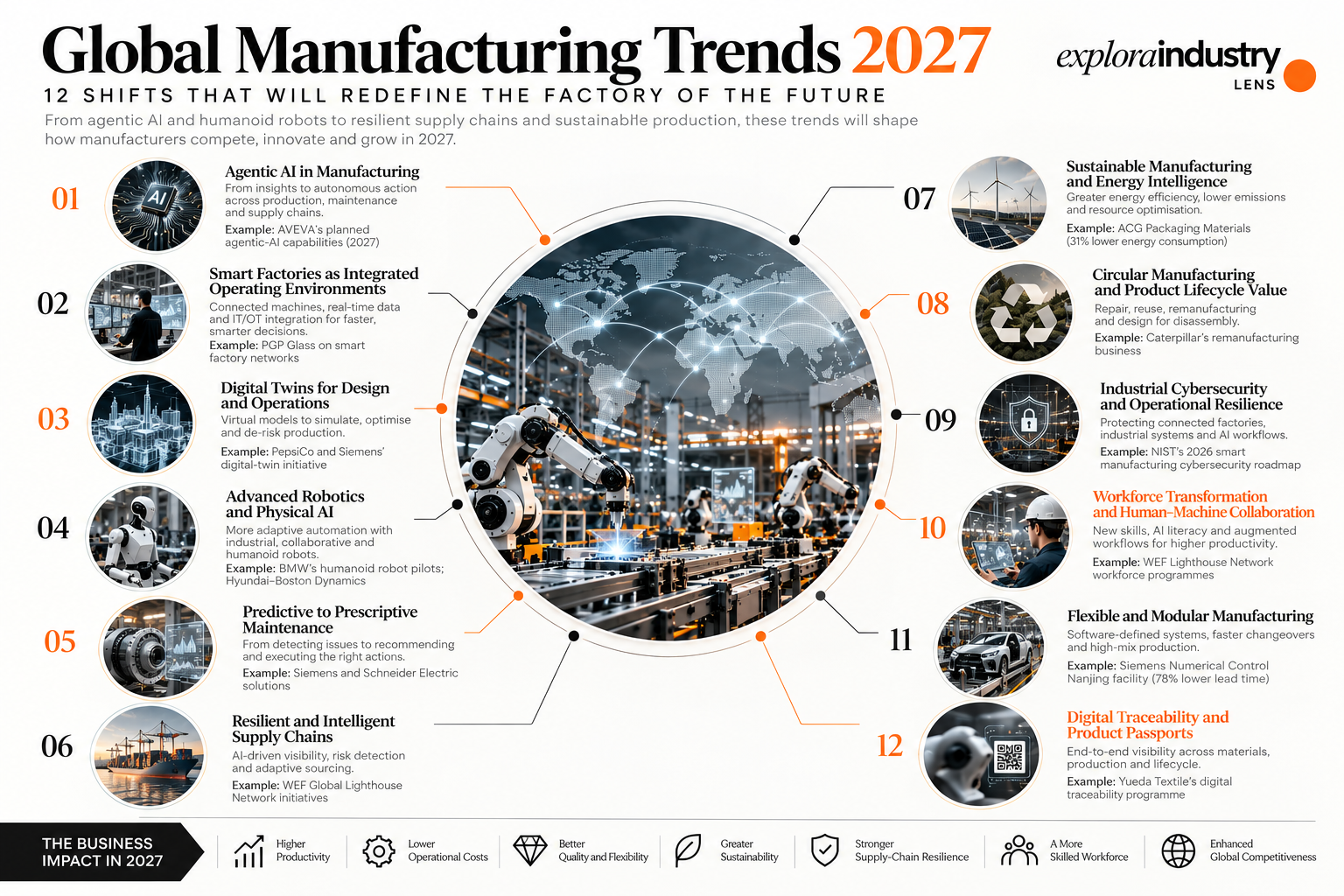
Manufacturing’s next transformation will not be defined by automation alone. It will be shaped by the ability of factories to interpret changing conditions, make better decisions and adapt production with greater speed, precision and resilience.
For decades, manufacturers have invested in industrial automation, connected machinery, enterprise software and data analytics. These investments created the foundation for smart manufacturing. The next phase is about making these systems more intelligent, interoperable and responsive to real-world conditions.
The direction is already visible. Siemens and NVIDIA are collaborating on industrial AI and digitalisation. BMW Group is piloting humanoid robots in production environments, while Boston Dynamics is developing manufacturing applications for its Atlas robot.
These developments do not mean every factory will become autonomous in 2027. Technology maturity, capital costs, workforce readiness, cybersecurity and integration challenges will continue to influence adoption.
However, they reveal the direction in which industrial competitiveness is moving.
Here are 12 manufacturing trends that business leaders should watch as they prepare for 2027.
1. Agentic AI will move manufacturing beyond dashboards and recommendations
What is changing? Manufacturing AI is evolving from systems that analyse data and generate recommendations towards applications that can plan and execute defined workflows under appropriate supervision.
Traditional industrial analytics help operators identify deviations, predict equipment failures and forecast demand. Agentic AI introduces the possibility of coordinating several steps: identifying a production constraint, evaluating alternative schedules, checking material availability and proposing an authorised response.
The wider industrial AI ecosystem is moving in this direction. Siemens and NVIDIA’s industrial AI partnership reflects efforts to combine industrial software, simulation, computing infrastructure and AI. Separately, AVEVA’s announcement of planned AI capabilities for its CONNECT platform illustrates how providers are exploring agentic AI and industrial knowledge models. The announced features should be understood as planned developments, not proof of widespread autonomous factory operations.
The strategic question is not whether an AI agent can generate an answer. It is whether it can act reliably with the right operational context, permissions and safeguards.
Manufacturing environments have strict requirements for quality, safety and uptime. Autonomous actions affecting equipment or production therefore need validation, oversight and accountability.
What manufacturers should do: Start with bounded workflows such as maintenance-ticket preparation, production exception analysis or inventory alerts. Expand autonomy only after demonstrating reliability and establishing clear approval controls.
2. Physical AI will bring robots closer to real-world industrial work
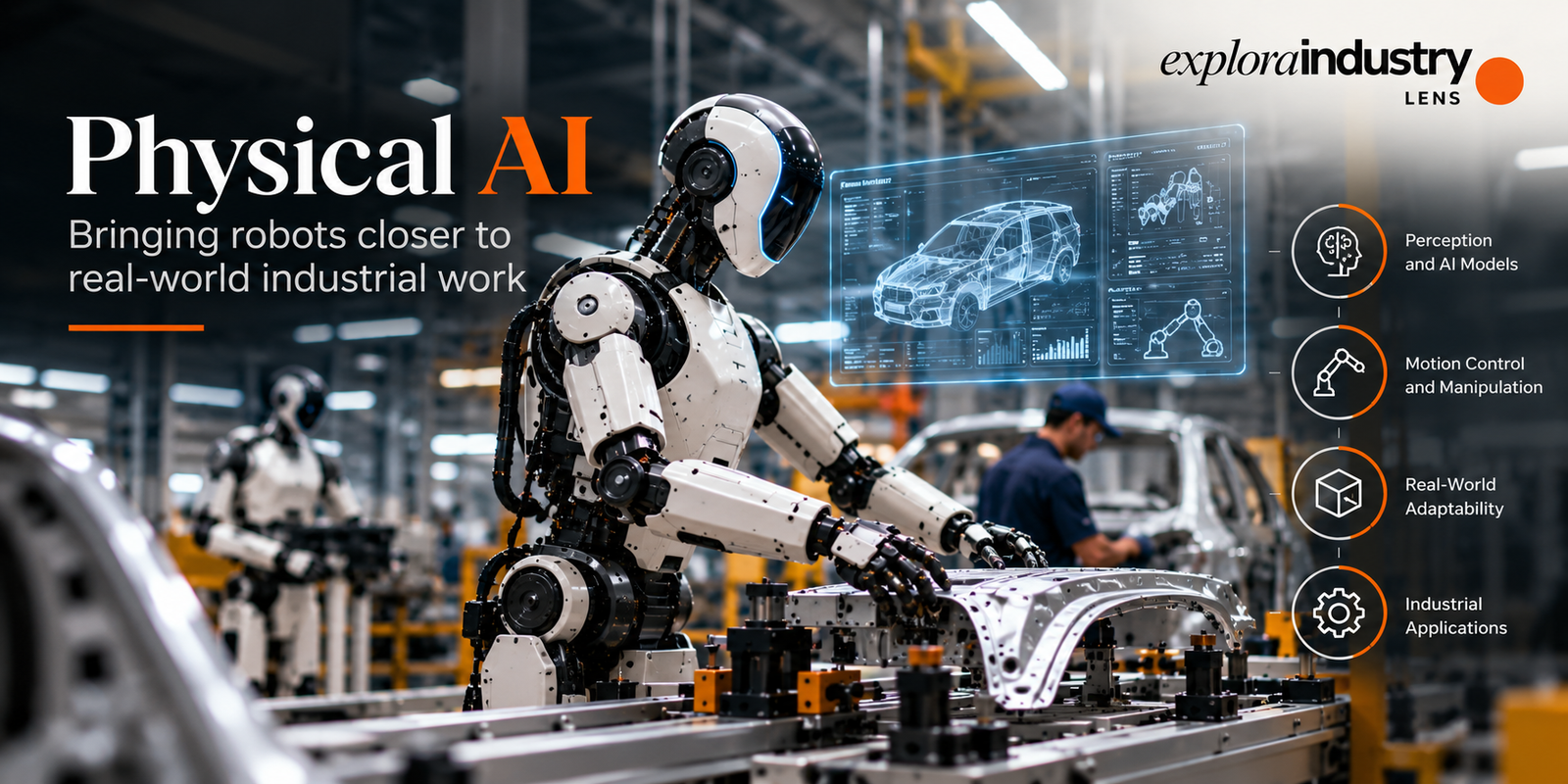
Physical AI combines AI models with sensors, perception, motion control and robotics, enabling machines to respond to their physical environment rather than merely follow fixed instructions.
This is significant for manufacturing, where unstructured tasks, product variation and changing conditions have historically limited automation.
The BMW Group’s humanoid robotics programme illustrates this transition. Following a pilot at its Spartanburg plant in the United States, BMW announced a further humanoid-robot pilot at its Leipzig plant in Germany. The initiative explores how physical AI can work alongside existing production systems.
Meanwhile, Hyundai Motor Group and Boston Dynamics are developing industrial applications for the Atlas humanoid robot. Boston Dynamics announced a dedicated application centre in September 2026 to train and test Atlas in manufacturing-related tasks.
These developments are important industrial experiments, but they should not be confused with evidence that humanoid robots are already economical replacements for conventional automation across factories.
What manufacturers should do: Evaluate physical AI against specific tasks involving material handling, inspection, logistics or repetitive work in changing environments. Compare its economics with established industrial robots, collaborative robots and autonomous mobile robots.
3. Digital twins will evolve from virtual models into decision environments
Digital twins allow manufacturers to model physical assets, products, processes and facilities. Their value increases when they are connected to operational data and used to evaluate decisions before those decisions affect the physical factory.
In 2027, an important development to watch will be the integration of digital twins with AI-assisted engineering, simulation and operational data.
Siemens offers digital twin capabilities spanning product design, production planning and manufacturing. NVIDIA Omniverse provides technologies for industrial simulation and physically based virtual environments. Across the wider ecosystem, industrial software providers are also exploring ways to organise fragmented information and make digital models more useful for analysis.
The potential applications include virtual commissioning, capacity planning, process optimisation, predictive maintenance and testing alternative production configurations.
However, a sophisticated visual representation is not automatically a useful digital twin. The model must reflect real operating conditions, integrate with relevant systems and support decisions that matter to the business.
What manufacturers should do: Prioritise digital twins for high-value decisions, such as factory expansion, equipment changes, production bottlenecks or expensive commissioning programmes. Measure their value against operational results rather than visual sophistication.
4. Software-defined factories will make production systems more adaptable
Manufacturing flexibility has traditionally depended on physical equipment, tooling and production-line design. Increasingly, software is becoming an important part of how industrial systems are configured, managed and upgraded.
Software-defined automation seeks to separate more of the control and application logic from fixed hardware configurations, potentially making systems easier to adapt and integrate.
IDC’s analysis of the AI-driven future of manufacturing identifies software-defined factories and more autonomous production scheduling among the developments manufacturers should watch.
The broader opportunity is to make production systems more adaptable without rebuilding large portions of the physical infrastructure every time requirements change. This could be particularly relevant to manufacturers managing high product variety, shorter product lifecycles or frequent changes in demand.
However, software-defined approaches must work with legacy equipment, industrial protocols, real-time constraints and functional-safety requirements.
What manufacturers should do: Assess automation architecture, interoperability and lifecycle costs when modernising plants. Avoid technology investments that create new vendor lock-in or make critical operations harder to maintain.
5. Industrial data context will become as important as data volume
Manufacturers have accumulated substantial volumes of machine data, maintenance records, engineering documents, quality reports and supply-chain information. Yet these assets frequently remain distributed across systems that do not share a common understanding of the underlying operation.
AI cannot reliably support complex manufacturing decisions if it cannot distinguish between machines, components, production stages, operating conditions and engineering constraints.
This is why industrial knowledge graphs, contextual data models and connected digital twins are attracting attention. These approaches aim to establish relationships between data points so that information can be interpreted in the context of a particular asset, process or operational objective.
The challenge is industry-wide rather than specific to any one software provider. Even advanced AI applications may produce unreliable recommendations when the underlying data is incomplete, inconsistent or disconnected from operational context.
The larger shift is from collecting more data to making existing data meaningful and usable across operational workflows.
What manufacturers should do: Map critical data relationships, standardise asset information and establish ownership for operational data. Treat context, governance and traceability as core components of AI readiness.
6. Humanoid robots will face their commercial reality test
Humanoid robots have attracted attention because their form factor could allow them to operate in environments designed around human workers. However, manufacturing requires far more than walking and manipulating objects.
Industrial deployment demands reliability, safe operation, repeatability, maintainability and a compelling economic case.
The BMW Group’s work with humanoid robots and Boston Dynamics’ manufacturing application centre demonstrate how manufacturers and robotics developers are evaluating these systems against real industrial tasks.
The distinction between a successful demonstration and commercially viable deployment will be crucial. A robot may perform a task under controlled conditions yet struggle with unexpected obstacles, variable components, downtime or the complexity of integrating into an existing production line.
In 2027, the more useful question will be whether pilot programmes demonstrate repeatable performance and a sustainable total cost of ownership.
What manufacturers should do: Evaluate demonstrated task performance, uptime, maintenance requirements, integration costs and cost per completed task. Compare humanoids with conventional automation before committing to large-scale deployment.
7. Autonomous production scheduling will become more intelligent
Production scheduling must balance orders, available materials, machine capacity, labour, maintenance windows and delivery commitments. When any of these variables change, planners often need to rework schedules manually.
AI-assisted scheduling can help manufacturers evaluate constraints and compare alternative plans more quickly. The next stage is greater automation in how schedules respond to operational changes.
IDC’s manufacturing analysis highlights the direction towards AI-driven scheduling and more autonomous integration of operational data.
The potential benefit is not simply faster scheduling. It is better coordination between production, procurement, maintenance and customer commitments. A change in material availability, for example, could trigger an assessment of alternative jobs, machine capacity and delivery implications.
However, automated scheduling is only as effective as the underlying data, constraints and decision rules. An apparently optimal schedule may still be impractical if it ignores setup times, workforce skills, quality requirements or supplier uncertainty.
What manufacturers should do: Start with a production line or plant where schedule changes are frequent and measurable. Compare schedule adherence, changeover time, delivery performance and planner workload before and after implementation.
8. Supply-chain resilience will become a continuous intelligence capability
Supply-chain resilience has moved beyond maintaining additional inventory or diversifying suppliers. Manufacturers increasingly need to identify emerging risks, understand dependencies and evaluate alternative responses as conditions change.
AI-assisted supply-chain planning can combine demand forecasts, supplier performance, logistics data, inventory positions and production constraints to support better decisions.
In 2027, the opportunity will be to connect this intelligence more closely with factory scheduling and commercial planning. A supply disruption should not remain a procurement alert. Ideally, its implications for production, customer commitments and alternative sourcing should become visible to decision-makers quickly.
This requires more than predictive analytics. Manufacturers need reliable supplier data, visibility beyond immediate suppliers, clear escalation procedures and the ability to evaluate trade-offs between cost, availability, lead time and risk.
What manufacturers should do: Map critical supplier dependencies, assess the availability of alternatives and establish escalation rules for disruptions. Use AI to support decisions, but retain clear accountability for commercially significant actions.
9. Energy intelligence will become integral to factory optimisation
Energy management is likely to remain a major manufacturing priority as companies balance operating costs, emissions targets, energy security and changing electricity requirements.
The next phase involves connecting energy data with production schedules, equipment performance and maintenance decisions.
Companies such as Schneider Electric and Siemens offer industrial automation and energy-management technologies that can help manufacturers monitor and optimise operational performance.
AI can potentially help identify energy-intensive operating patterns, compare production scenarios and coordinate energy use with equipment and process requirements. For example, a manufacturer may be able to identify when energy consumption rises without a corresponding increase in output, or evaluate whether production schedules can be adjusted without compromising delivery commitments.
The business case varies considerably by industry. Energy-intensive processes, continuous production facilities and plants with significant peak-demand exposure may have different priorities from smaller assembly operations.
What manufacturers should do: Establish energy baselines at equipment and process levels. Evaluate interventions using both energy savings and production requirements, rather than treating energy efficiency as an isolated reporting exercise.
10. Industrial cybersecurity will have to keep pace with AI adoption
The expansion of AI, connected equipment and autonomous workflows creates additional cybersecurity and operational-risk considerations.
Manufacturers must protect not only business systems and confidential data but also industrial control systems, operational technology networks and the integrity of data used by AI applications.
The US National Institute of Standards and Technology’s 2026 roadmap for AI and machine learning in smart manufacturing highlights challenges involving industrial data, system integration, reliability and trustworthy operation in high-stakes environments.
As manufacturers give AI systems greater responsibility, they will need stronger controls over access, permissions, monitoring, model performance and the actions systems can execute.
Cybersecurity must also account for legacy equipment, suppliers, remote maintenance and the consequences of production downtime. A compromised business application and a compromised industrial control system can have very different operational consequences.
What manufacturers should do: Integrate AI governance with existing operational technology security and safety processes. Test systems against realistic failure scenarios, restrict autonomous permissions and establish clear recovery procedures.
11. Human-machine collaboration will become a core manufacturing capability
Automation does not eliminate the need for human expertise. Instead, it changes where that expertise is applied.
As AI systems become more capable, manufacturing employees may spend less time collecting information manually and more time supervising automated processes, investigating exceptions, improving workflows and making decisions that require contextual judgement.
The challenge is ensuring that employees have the skills and confidence to work effectively with increasingly intelligent systems.
The World Economic Forum’s Global Lighthouse Network documents examples of advanced manufacturing transformation. The broader lesson for manufacturers is that technology adoption must be accompanied by changes in skills, operating models and ways of working.
Human-machine collaboration also requires thoughtful system design. Workers need to understand when AI recommendations can be trusted, when human intervention is required and how to escalate errors or unexpected behaviour.
What manufacturers should do: Make workforce development part of every technology programme. Build practical AI literacy, provide task-specific training and involve frontline employees in evaluating new systems.
12. Traceability and circular manufacturing will become more closely connected
Manufacturers are under growing pressure to understand material origins, product composition, quality history and lifecycle performance.
Digital traceability can support compliance, quality investigations, product recalls and customer assurance. It can also help companies identify opportunities for repair, reuse, remanufacturing and material recovery.
Caterpillar’s remanufacturing business illustrates how component recovery and reuse can form part of an established industrial business model. By recovering and remanufacturing components, industrial companies can create value beyond the initial sale of a product.
Digital product information and traceability systems may strengthen these models by making it easier to track components, document maintenance history and assess whether products or materials can be recovered for further use.
Requirements will vary by jurisdiction, industry and product type. The pace of adoption will depend on regulation, customer expectations, available infrastructure and the economics of circular business models.
What manufacturers should do: Identify relevant customer and regulatory requirements, improve product data quality and evaluate whether traceability can support both compliance and commercially viable circular services.
Five priorities for manufacturing leaders preparing for 2027
Technology investments should be guided by operational priorities rather than forecasts alone.
1. Establish AI readiness. Assess data quality, integration, governance and the suitability of specific workflows for AI-assisted or autonomous execution.
2. Modernise selectively. Prioritise equipment, software and infrastructure upgrades that address measurable operational constraints.
3. Validate robotics economics. Compare conventional automation, collaborative robots and emerging physical-AI systems using real production requirements.
4. Connect resilience with planning. Integrate supplier-risk visibility with inventory, production schedules and customer commitments.
5. Invest in people and security. Build workforce capabilities and safeguards alongside every expansion of automation or AI.
These priorities provide a practical bridge between today’s manufacturing capabilities and the more adaptive operating models emerging for 2027.
Conclusion: The next factory advantage will be adaptability
The manufacturing trends shaping 2027 point towards a more intelligent and interconnected industrial environment. Agentic AI, physical robotics, digital twins and software-defined automation could change how factories make decisions and respond to disruption.
Yet technology maturity will remain uneven. Some capabilities will become commercially useful in specific applications, while others will require further validation, investment and operational learning.
The companies best positioned to benefit will not necessarily be those that adopt the most technologies. They will be those that connect the right technologies to the right business problems, integrate them with reliable data and processes, and scale successful deployments without compromising safety or resilience.
For manufacturing leaders, the defining question for 2027 is not simply how much of the factory can be automated.
It is how intelligently the factory can adapt and how consistently that adaptability translates into productivity, quality, resilience and profitable growth.
Editorial note: This article is an independent, forward-looking assessment of global manufacturing trends. It is not sponsored or commissioned by the companies mentioned. Company examples are illustrative and do not imply endorsement. Announced product plans, company pilots, industry forecasts and established capabilities are distinguished in the text. Future adoption and commercial outcomes remain uncertain.
Explora Industry Lens covers manufacturing, industrial innovation, supply chains, technology and global business trends.
© 2026 Emergent Industry Lens
Want to be published on EI Lens? Drop a note to us and we will get in touch!