

Europe is reworking the rules governing biotechnology, pharmaceuticals, clinical evidence, health data and artificial intelligence. For life sciences companies, the challenge is no longer just regulatory compliance. It is understanding how these interconnected frameworks will influence innovation, investment, manufacturing and patient access.
Europe is entering a consequential period of change for its life sciences industry. A series of legislative reforms and regulatory initiatives is addressing different parts of the innovation lifecycle: how scientific discoveries are funded, how biotechnology companies scale, how medicines are authorised, how clinical evidence is assessed, how health data can be used, and how AI-enabled technologies are governed.
Five policy frameworks are central to this shift: the proposed European Biotech Act, the reform of EU pharmaceutical legislation, the European Health Data Space (EHDS), the Health Technology Assessment Regulation (HTAR) and the EU AI Act.
These initiatives have different legal statuses, implementation schedules and objectives. Their significance lies not in any single regulation, but in how they may collectively change the environment in which life sciences companies research, develop, manufacture and commercialise products.
For pharmaceutical companies, biotechnology developers, medtech manufacturers, clinical research organisations and investors, understanding these connections is becoming a strategic requirement.
Why Europe is reassessing its life sciences strategy
The European Union has a substantial life sciences base. The European Commission’s Strategy for European Life Sciences describes a sector generating approximately €1.5 trillion in economic value and supporting around 29 million jobs across the EU.
However, Europe’s scientific capabilities do not automatically translate into global commercial leadership. Competition for research investment, clinical trials, manufacturing capacity and the commercialisation of new medicines has intensified.
According to EFPIA’s analysis of pharmaceutical R&D spending, pharmaceutical R&D expenditure in Europe increased from €27.8 billion in 2010 to €46.2 billion in 2022. Average annual growth over that period was 4.4%, compared with 5.5% in the United States and 20.7% in China. These figures describe a historical period rather than the current annual growth rate, but they illustrate the competitive pressure facing Europe.
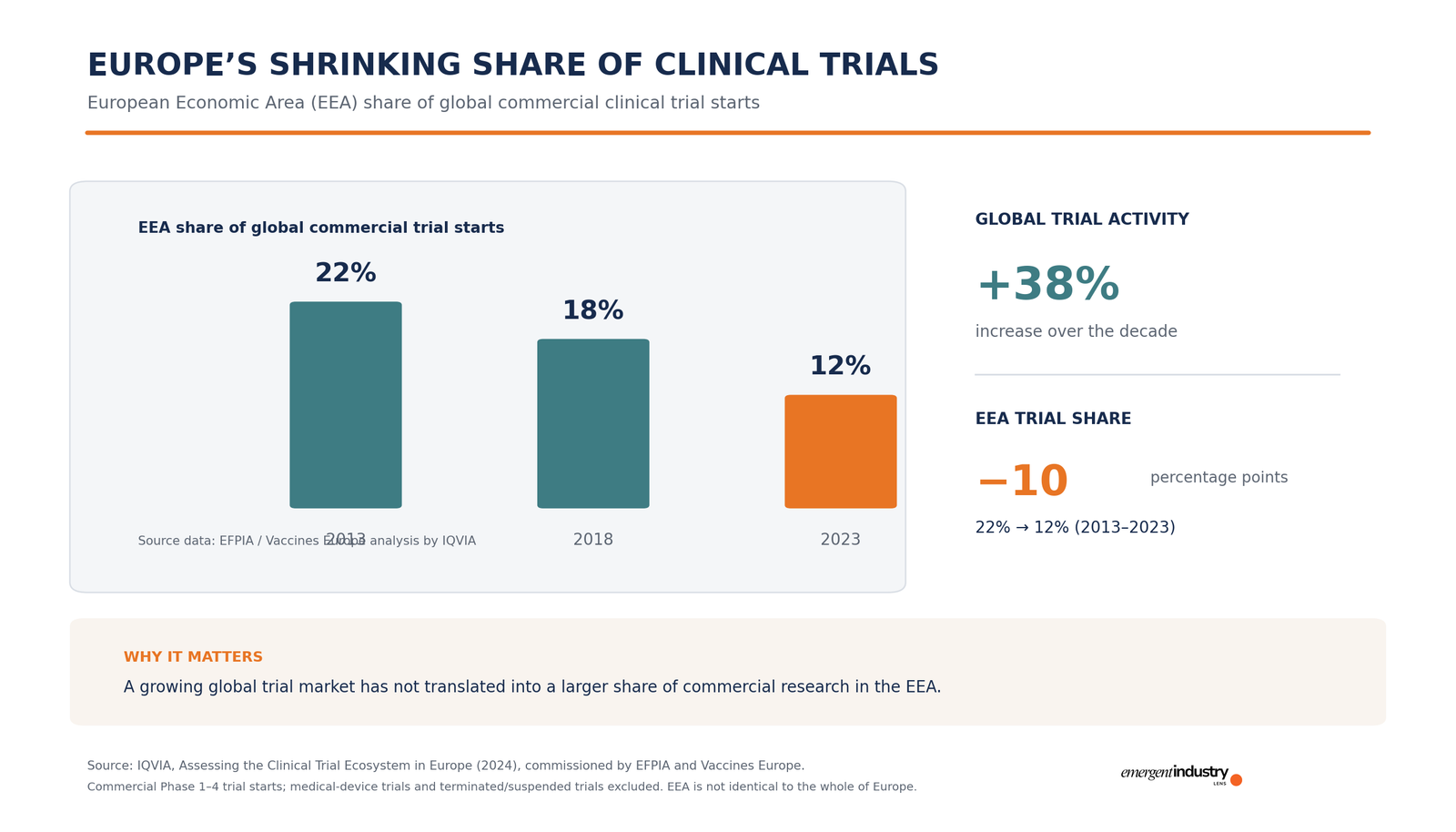
Europe’s challenge is multidimensional. It must sustain scientific research, improve the conditions for scaling innovative businesses, strengthen manufacturing resilience and make new treatments available to patients without compromising safety and evidence standards.
The regulatory reset is an attempt to address several of these challenges through complementary policy measures.
1. European Biotech Act: Building a stronger biotechnology industry
The European Biotech Act is a central component of the EU’s effort to strengthen biotechnology and biomanufacturing. The European Commission published its legislative proposal on 16 December 2025. The official proposal on EUR-Lex sets out a framework of measures intended to strengthen the Union’s biotechnology and biomanufacturing sectors, particularly in health.
Unlike legislation focused primarily on the authorisation of individual medicines, the Biotech Act is intended to improve the broader environment in which biotechnology is researched, financed, developed and manufactured.
Its proposed measures address several important areas.
Strategic projects and biomanufacturing capacity
The proposal seeks to support strategic health biotechnology projects and high-impact projects. Its broader objective is to strengthen Europe’s capacity to translate research into industrial production, develop specialist skills, improve supply-chain resilience and support biotechnology clusters.
For developers of biologics, vaccines, advanced therapies and other biotechnology products, this could create opportunities for more coordinated support for manufacturing scale-up.
Strategic recognition should not be confused with automatic funding, guaranteed commercial advantage or an exemption from product-specific regulatory requirements.
Access to investment and capital
Biotechnology businesses often face long development cycles, high research costs and substantial capital requirements before generating revenue. These characteristics can make it difficult for start-ups and scale-ups to move from promising laboratory research to commercial manufacturing.
The proposal includes an EU Health Biotechnology Investment Pilot involving the European Investment Bank Group and other implementing partners. It is intended to help address investment barriers in the sector.
The Commission’s wider BioTechEU initiative also seeks to mobilise investment in biotechnology. These wider investment ambitions should be distinguished from specific funding entitlements under the proposed Act: individual companies will need to meet the applicable eligibility and financing conditions.
For investors and founders, the relevant questions will be which financing instruments become available, what eligibility conditions apply and whether capital reaches businesses at the stages where funding gaps are most acute.
Innovation incentives and biosimilars
The package proposes measures intended to support Europe’s biosimilar sector and includes a proposed 12-month extension of supplementary protection certificate protection for qualifying biotechnology-derived medicinal products and advanced therapy medicinal products, subject to the proposal’s conditions.
These measures could influence investment decisions, intellectual property planning and the competitive relationship between innovative medicines and biosimilars.
The commercial effects will depend on the final legislation and its interaction with existing intellectual property and pharmaceutical rules.
AI and data in biotechnology
The proposal seeks to facilitate the use of AI and digital tools across biotechnology research, development, manufacturing and regulatory processes. It also addresses access to appropriate data and testing environments.
AI can support activities such as identifying drug candidates, analysing biological data, optimising manufacturing processes and improving aspects of clinical development. Yet its use in life sciences also raises questions about data quality, validation, explainability, security and accountability.
The Biotech Act does not replace the EU AI Act or data-protection legislation. Companies will need to understand how the proposed biotechnology measures interact with those existing frameworks.
Regulatory simplification and clinical research
The proposal includes measures intended to improve regulatory coordination and streamline aspects of clinical-trial procedures. It also seeks to provide more predictable pathways for novel and borderline biotechnology products, with regulatory sandboxes among the mechanisms envisaged.
For biotechnology developers and contract research organisations, the potential benefit is greater predictability across development programmes and fewer avoidable administrative bottlenecks.
That does not mean automatic approval or reduced standards for safety, quality and efficacy. The practical benefits will depend on the final provisions and their implementation by the relevant authorities.
Biosecurity and biodefence
The Act also addresses the potential misuse of biotechnology and the need to strengthen biosecurity and biodefence capabilities.
This reflects a broader challenge for the industry: enabling innovation while managing risks associated with potentially dangerous biological technologies.
What it means for industry: The Biotech Act should be understood as an attempt to connect scientific capability with investment, manufacturing and commercialisation. Its impact will depend on the final legal text, funding arrangements, implementation and the ability of companies to navigate the other rules that apply to their products.
2. EU pharmaceutical legislation reform: Balancing innovation, access and competition
The reform of EU pharmaceutical legislation addresses the rules governing medicines, including regulatory protection, incentives for innovation, generic and biosimilar competition, medicine availability and security of supply.
On 28 September 2026, the Council of the European Union adopted the pharmaceutical package. As detailed in the Council’s announcement on the new pharmaceutical rules, the package still requires completion of the European Parliament’s adoption process before the new rules enter into force following publication in the Official Journal.
The reform seeks to balance several policy objectives:
- Encouraging meaningful pharmaceutical innovation and investment.
- Improving access to safe, effective and affordable medicines.
- Addressing shortages and strengthening security of supply.
- Modernising regulatory procedures and reducing unnecessary administrative burdens.
- Supporting competition from generic and biosimilar medicines.
- Improving incentives and measures addressing antimicrobial resistance and priority medicines.
For pharmaceutical companies, the consequences extend beyond regulatory submissions. Changes to incentives and regulatory protection can influence product portfolios, launch sequencing, research priorities, intellectual property strategies and expected returns on investment.
For generic and biosimilar manufacturers, the evolving framework will influence competition and the timing of market opportunities.
For health systems and patients, the intended objective is better access to medicines while maintaining incentives for research and development.
The final impact will depend on the enacted provisions, transition arrangements and subsequent implementation. Companies should avoid making investment or launch decisions based solely on summaries of political agreements or earlier legislative proposals.
3. European Health Data Space: Creating a framework for health data exchange and reuse
Health data is increasingly important to drug discovery, clinical research, real-world evidence, personalised medicine and public health. Yet data remains fragmented across healthcare providers, national systems and technical platforms.
The European Health Data Space Regulation aims to establish common rules, infrastructure and governance for electronic health data. It addresses both the primary use of data for healthcare and the secondary use of data for permitted purposes such as research, innovation and public health.
The regulation entered into force on 26 March 2025, but its implementation is phased.
What the EHDS changes
The framework is intended to support more consistent electronic health data exchange, strengthen individual rights over health data, improve interoperability of electronic health record systems and establish governed pathways for permitted secondary use.
For life sciences companies, the secondary-use framework is particularly important. Subject to the regulation’s conditions, authorised users may be able to access specified health datasets for permitted research and innovation purposes through the relevant governance and secure-processing arrangements.
This is not unrestricted access to patient records. Access will be governed by legal purposes, safeguards, authorisation procedures and controls on how data can be used.
Why this matters for pharmaceutical and biotechnology companies
Better access to appropriately governed health data could support clinical research feasibility, patient recruitment, real-world evidence generation, research into disease patterns and treatment outcomes, evaluation of medicine safety and effectiveness, and development of data-driven health technologies.
The value of the EHDS will depend on implementation quality. Data interoperability, completeness, representativeness, access procedures, privacy protection and technical readiness will all affect its usefulness.
EHDS implementation timeline
According to the official EUR-Lex summary of the EHDS Regulation, key milestones include:
- March 2025: The regulation entered into force.
- March 2027: Deadline for the Commission to adopt key implementing acts.
- March 2029: Major initial application milestones, including cross-border exchange of patient summaries and electronic prescriptions and dispensations, and secondary-use rules for most data categories.
- March 2031: Further categories, including medical imaging, laboratory results and hospital discharge reports, enter the relevant exchange framework; secondary-use rules also extend to remaining categories such as genomic data.
- March 2035: Under specified conditions, non-EU countries and international organisations may apply to join HealthData@EU for secondary use.
These dates concern different obligations and data categories; they should not be interpreted as a single deadline by which every part of the EHDS becomes fully operational.
What it means for industry: Companies should begin assessing data provenance, interoperability, governance, privacy controls and evidence-generation strategies well before the relevant implementation milestones. Access to more data will not automatically guarantee access to every dataset or remove the need for rigorous research design.
4. Health Technology Assessment Regulation: Aligning clinical evidence across Europe
Regulatory approval establishes whether a medicine meets the applicable requirements for quality, safety and efficacy. Health technology assessment asks a different question: how does a health technology perform clinically compared with relevant alternatives, and what does that evidence mean for healthcare decision-making?
The EU Health Technology Assessment Regulation introduces joint clinical assessment procedures for specified health technologies. It has applied since 12 January 2025, as explained in the European Commission’s HTAR implementation guidance.
What changes under HTAR?
The initial phase covers new cancer medicines and advanced therapy medicinal products. The scope expands to orphan medicines in January 2028 and to other new medicinal products within the regulation’s scope in January 2030. Certain medical devices are also included through a phased approach.
Joint clinical assessment is intended to reduce duplication of clinical evidence assessment across Member States and improve consistency in how clinical outcomes are examined.
For manufacturers, this increases the importance of planning evidence generation with multiple European markets in mind from the outset.
What HTAR does not do
HTAR does not create a single EU-wide reimbursement decision or automatically determine medicine prices.
National authorities retain responsibility for decisions such as pricing, reimbursement and the organisation of healthcare. National assessments may still consider additional elements within their remit.
Implications for evidence strategy
Companies should align clinical development with the evidence needed to demonstrate comparative clinical benefit, relevant patient outcomes and uncertainty around treatment effects.
This includes thinking early about comparator selection, endpoints, subgroups, evidence gaps and the consistency of evidence submitted across markets.
What it means for industry: Joint assessment can reduce duplicated clinical work, but it may also expose evidence gaps earlier and increase the value of integrated clinical, regulatory and market-access planning.
5. EU AI Act: Governing AI across the life sciences value chain
Artificial intelligence is increasingly used in drug discovery, clinical trials, medical imaging, diagnostics, manufacturing, pharmacovigilance and healthcare operations.
The EU AI Act establishes a risk-based framework for AI systems. Its obligations depend on factors including the system’s intended purpose, classification and role in a regulated product.
Some AI systems used in medical devices and in vitro diagnostic devices may be classified as high-risk where the relevant legal conditions are met. Not every AI application in healthcare or life sciences is automatically a high-risk system.
The AI Act also interacts with existing sectoral legislation, including the Medical Devices Regulation and In Vitro Diagnostic Medical Devices Regulation.
What companies need to assess
Life sciences organisations should evaluate:
- The intended purpose and risk classification of each AI system.
- Data quality, representativeness and governance.
- Validation, performance monitoring and documentation.
- Human oversight and accountability.
- Cybersecurity and technical robustness.
- Supplier responsibilities and the allocation of compliance duties.
- Interaction with medical-device, medicines and data-protection requirements.
The AI Act’s application is phased. As explained in the Commission’s AI Act implementation guidance, some provisions are already applicable, while high-risk AI requirements and certain obligations for AI embedded in regulated products have later scheduled dates. Companies should verify the current legal position and any adopted amendments rather than relying on an earlier timeline alone.
What it means for industry: AI governance should be built into product development and quality systems rather than treated as a final compliance check. Companies need to understand both the AI-specific rules and the sectoral requirements that apply to the product or process in which AI is used.
How the five frameworks interact
The five frameworks address different stages of the life sciences value chain. Their combined effect is more important than any one measure in isolation.
| Framework | Primary focus | Strategic question for companies |
|---|---|---|
| European Biotech Act | Investment, scale-up, biomanufacturing and biotechnology innovation | Can we fund, develop and manufacture our innovation competitively in Europe? |
| Pharmaceutical legislation reform | Medicines regulation, incentives, availability and supply security | How will the evolving rules affect our product strategy and commercial returns? |
| European Health Data Space | Health data exchange, access and permitted reuse | Can we generate and use high-quality evidence within the applicable governance framework? |
| HTAR | Joint clinical assessment | Will our evidence demonstrate clinical value across relevant European markets? |
| EU AI Act | Risk-based AI governance | Can our AI systems meet the requirements applicable to their purpose and classification? |
Consider a biotechnology company developing an AI-assisted therapy.
The Biotech Act could influence its access to investment and support for scale-up if the relevant measures are adopted and the company qualifies. Pharmaceutical and clinical-trial rules would govern the relevant development and authorisation pathway. The EHDS could create opportunities for permitted research using health data. HTAR could shape the comparative clinical evidence required for assessment. The AI Act and applicable sectoral rules could govern relevant AI components.
Each framework has its own scope and legal requirements. Compliance with one does not automatically establish compliance with the others.
The practical implication is that regulatory strategy, clinical evidence, data governance, AI oversight, manufacturing and market access should be planned together.
Five challenges life sciences companies should prepare for
1. Regulatory overlap
Multiple frameworks may apply to the same product, dataset or development programme. Companies need a clear map of which rules apply, when they apply and who is responsible for each obligation.
2. Implementation uncertainty
A legislative proposal, an adopted regulation and an implementing act are not interchangeable. Companies must distinguish proposed changes from binding obligations and track the relevant transition periods.
3. Evidence and data readiness
Clinical evidence, real-world data and AI validation are becoming more interconnected. Organisations should review evidence gaps, data quality, interoperability and governance before major development or market-access decisions.
4. Uneven national market access
EU-level clinical assessment does not eliminate differences in national pricing, reimbursement and healthcare delivery. Companies still need country-specific access strategies.
5. Capital and manufacturing constraints
Regulatory reform cannot by itself solve every financing, skills or infrastructure challenge. Companies must assess whether access to funding, specialist talent, manufacturing capacity and supply-chain partners matches their development plans.
What life sciences leaders should do now
The most useful response is to translate the policy changes into a practical operating plan.
Map regulatory obligations. Build a framework-by-framework register covering current requirements, proposals, responsible teams, milestones and dependencies.
Review clinical and evidence strategy. Align clinical development, comparator selection, endpoints and evidence planning with regulatory requirements and anticipated health technology assessment needs.
Prepare for health data governance. Review data provenance, consent and other applicable legal bases, interoperability, access permissions, security and permitted secondary use.
Establish AI governance. Inventory AI systems, determine their intended purpose and classification, document validation and monitoring, and clarify accountability across suppliers and internal teams.
Assess manufacturing and investment options. Monitor the final Biotech Act provisions and any related funding mechanisms. Evaluate scale-up capacity, strategic partnerships and supply-chain resilience without assuming that proposed support will automatically be available.
Track national market access. Continue to plan for differences in pricing, reimbursement, procurement and healthcare systems across European markets.
Monitor the legal status of each initiative. Assign responsibility for tracking formal adoption, publication, implementation acts, guidance and transition periods. Regulatory intelligence should be treated as an ongoing business process, not a one-off legal review.
Conclusion: Europe is trying to connect innovation with industrial competitiveness
Europe’s life sciences regulatory reset is not a single legislative event. It is a set of interrelated initiatives addressing investment, manufacturing, medicines regulation, health data, clinical evidence and AI governance.
The proposed European Biotech Act adds an important industrial and investment dimension to this agenda. Pharmaceutical legislation reform addresses the rules and incentives governing medicines. The EHDS seeks to create a governed framework for health data exchange and reuse. HTAR introduces joint clinical assessment, while the AI Act establishes risk-based rules for AI systems.
Together, these measures aim to create conditions in which Europe can translate scientific capability into commercially viable products and better patient access.
Whether the ambition is realised will depend on the final legal provisions, implementation across Member States, investment decisions and the ability of companies to navigate overlapping requirements.
For life sciences leaders, the immediate priority is clear: understand the legal status of each framework, anticipate the evidence and governance requirements, and integrate regulatory planning with investment, product development, manufacturing and market access.
Europe’s next phase of life sciences competitiveness will depend not only on what it discovers, but also on how effectively it develops, evaluates, manufactures and delivers those innovations.
Frequently asked questions
What is the European Biotech Act?
The European Biotech Act is a legislative package proposed by the European Commission on 16 December 2025 to strengthen biotechnology and biomanufacturing, particularly in health. Its proposed measures address strategic projects, investment, innovation, regulatory coordination, AI and data, and biosecurity. See the official Commission proposal.
What are the five major EU life sciences regulatory frameworks?
The five frameworks discussed here are the European Biotech Act, pharmaceutical legislation reform, the European Health Data Space Regulation, the Health Technology Assessment Regulation and the EU AI Act. They address different aspects of innovation, medicines, data, evidence and AI governance.
Does the European Health Data Space give pharmaceutical companies unrestricted access to patient data?
No. The EHDS establishes a governed framework for primary and permitted secondary use of electronic health data. Access depends on applicable legal conditions, authorised purposes, safeguards and access procedures.
Does the EU Health Technology Assessment Regulation determine medicine prices across Europe?
No. HTAR introduces joint clinical assessment for specified health technologies. Pricing, reimbursement and the organisation of healthcare remain within national responsibilities.
Does the EU AI Act apply to every AI tool used by a pharmaceutical company?
Not automatically in the same way. Obligations depend on the system, its intended purpose, classification and role. Certain AI systems used in medical devices or in vitro diagnostics may be high-risk, and applicable sectoral rules may also apply.
What should biotechnology and pharmaceutical companies do first?
Companies should map the frameworks relevant to their products, distinguish binding requirements from proposals, review clinical evidence and data governance, assess AI obligations and manufacturing plans, and monitor implementation dates and national market-access requirements.
Editorial disclaimer: This article is intended for informational and educational purposes only and reflects the regulatory landscape as understood at the time of publication. It does not constitute legal, regulatory, medical, investment or professional advice. Legislative status, regulatory requirements and implementation timelines may change. Readers should consult official EU publications and qualified professionals before making business, compliance or investment decisions. While reasonable efforts have been made to ensure accuracy, Emergent Industry Lens makes no representation or warranty regarding the completeness, accuracy or continued validity of the information presented. Interpretations expressed are editorial analysis and should not be construed as official guidance from any regulatory authority.