Material innovation, circularity and manufacturing transformation are reshaping the global metal packaging industry. As demand patterns shift towards Asia-Pacific, the next phase of growth will depend on more than the material itself.
Metal packaging has long been valued for its durability, product protection and recyclability. Aluminium beverage cans, steel food containers, aerosol cans and speciality metal formats remain important across food, beverages, healthcare and personal care. But the industry is entering a period of transition.
Manufacturers are navigating changing consumer preferences, pressure to reduce material use, competition from alternative packaging formats and increasingly demanding sustainability regulations. At the same time, advances in manufacturing technology and investment in emerging markets are creating new opportunities.
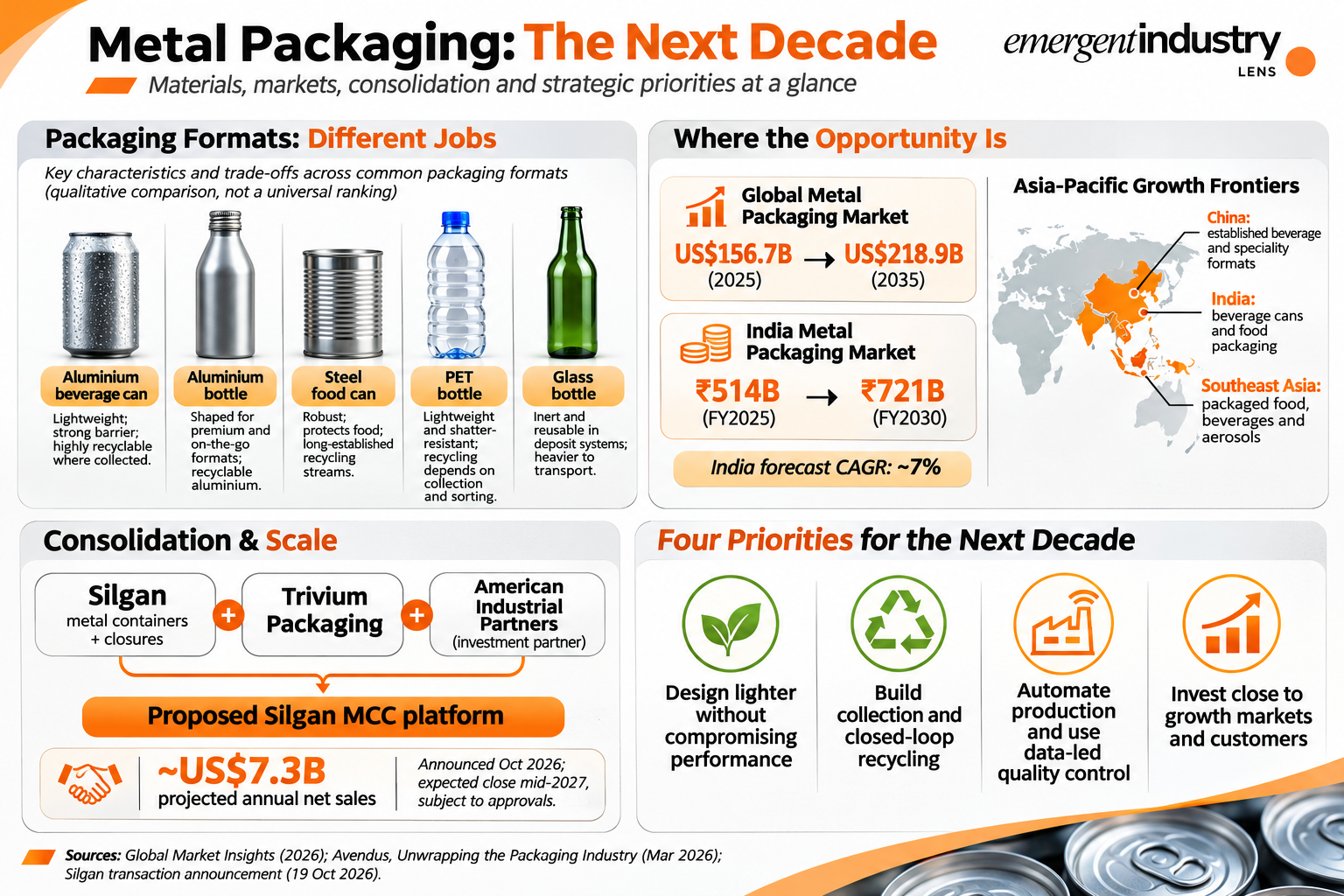
According to Global Market Insights, the global metal packaging market was valued at approximately US$156.7 billion in 2025 and is projected to reach US$218.9 billion by 2035, growing at a CAGR of around 3.5% between 2026 and 2035.
The opportunity, however, is not simply about producing more cans and containers. It is about making metal packaging lighter, more resource-efficient and economically competitive while strengthening the systems that recover and recycle it.
Asia-Pacific: The Next Growth Opportunity
The industry’s growth story is increasingly shaped by regional differences. Mature markets in North America and Europe are focused on operational efficiency, recycled content and regulatory compliance. Asia-Pacific, meanwhile, offers opportunities linked to urbanisation, rising consumption, expanding food processing and growing demand for packaged beverages.
India is one of the region’s most promising markets. According to Avendus’ March 2026 report, Unwrapping the Packaging Industry: A Structural Consumer Growth Proxy, the Indian metal packaging market was valued at approximately ₹514 billion in FY2025 and is projected to reach ₹721 billion by FY2030, representing a CAGR of around 7%. The cans segment alone is expected to grow from ₹315 billion to ₹484 billion over the same period.
Investment announcements reflect this opportunity. CANPACK selected Uttar Pradesh for its third beverage-can manufacturing facility in India, while AGI Greenpac announced a ₹1,000 crore aluminium can manufacturing project in the state.
China and Southeast Asia offer different but complementary demand drivers. Established beverage markets, evolving consumption habits and demand for convenient formats are influencing product development. Euromonitor’s analysis of metal packaging in Asia-Pacific highlights applications ranging from metal beverage bottles in China to aerosol packaging in Indonesia and ready-to-drink coffee formats in Japan.
For manufacturers, the region is not simply a volume-growth opportunity. It requires investment in local production, customer relationships, supply-chain resilience and packaging formats suited to distinct markets.
The Sustainability Equation: Beyond Recyclability
Metal packaging has a strong sustainability proposition, particularly because aluminium and steel can be recycled repeatedly without losing their fundamental material properties. Yet recyclability alone does not guarantee circularity.
Collection infrastructure, sorting efficiency, recycling capacity, contamination and the availability of high-quality recycled material determine how much packaging actually returns to production.
A 2026 global beverage-container recycling dataset, developed by Eunomia Research & Consulting for the Global Beverage Can Circularity Alliance, reported collection rates of 77% for aluminium cans and 69% for PET bottles. The reported recycling rates were 76% and 54%, respectively. These figures are useful indicators, although they should be understood in the context of the dataset’s methodology and industry backing.
The challenge for metal packaging producers is to improve the entire lifecycle, from sourcing and manufacturing to collection and recycled-material use.
Lightweighting is another important part of this transition. Reducing the amount of metal used in each container can lower material consumption, transport weight and production-related emissions. However, thinner packaging must still withstand filling, transportation, storage and consumer handling.
The industry must also compete with plastic, glass and flexible packaging. Each material has different cost, weight, barrier and recovery characteristics. Metal’s advantages are strongest where product protection, shelf life, pressure resistance and established recycling systems matter. Its long-term competitiveness will depend on delivering these benefits with lower resource intensity.
Regulation is adding urgency. The European Union’s Packaging and Packaging Waste Regulation (PPWR), which began applying on 12 August 2026, introduces a broader framework for packaging design, waste prevention, recyclability and recycled materials. Although its requirements cover multiple packaging materials, they reinforce the need for manufacturers to demonstrate measurable lifecycle performance rather than rely on sustainability claims alone.
The Factory of the Future
Material innovation is only one part of the industry’s transformation. Manufacturing processes are also evolving as producers seek to improve efficiency, consistency and product differentiation.
Advances in coatings and internal linings are important because packaging must protect products without compromising safety, quality or shelf life. Lightweighting and forming technologies are enabling manufacturers to use less material while maintaining structural performance. Improvements in printing and decoration are also helping brands differentiate products on crowded retail shelves.
Automation, machine vision, real-time process monitoring and data-led quality control can help reduce defects, material waste and downtime. For high-volume manufacturers, even incremental improvements in line efficiency can have significant commercial value.
The next competitive advantage may therefore come from integrating material science with intelligent manufacturing and designing packaging that uses fewer resources and producing it with greater precision.
Consolidation and the Search for Scale
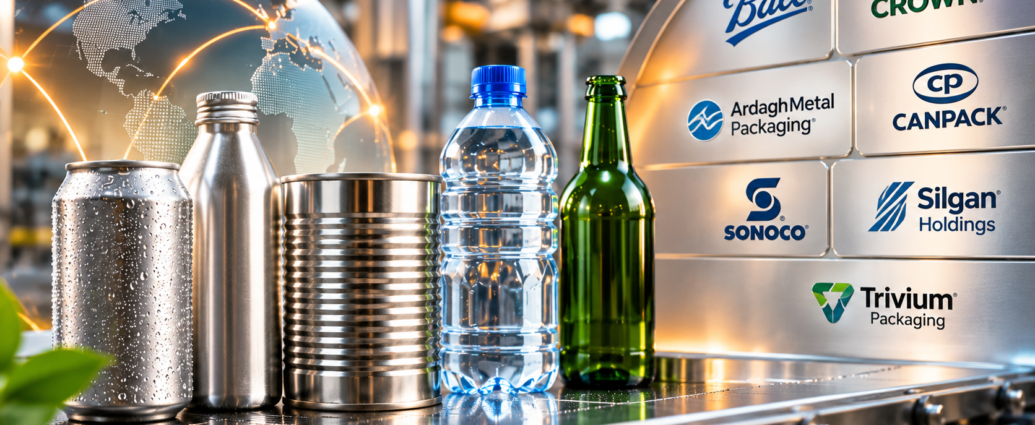
The competitive landscape is also changing. Established players such as Ball Corporation, Crown Holdings, Ardagh Metal Packaging, CANPACK, Sonoco and Silgan are positioning themselves around scale, operational efficiency, customer relationships and innovation.
The proposed Silgan–Trivium transaction is one example of this strategic repositioning. Announced in October 2026, the partnership with American Industrial Partners is intended to combine Silgan’s metal containers and food and beverage closures businesses with Trivium Packaging, creating a global metal packaging platform with projected annual net sales of approximately US$7.3 billion.
The companies expect the transaction to generate annual synergies of US$225 million by the end of the third year following completion. It is expected to close in mid-2027, subject to regulatory approvals and other customary conditions. The details are set out in Silgan’s announcement.
The deal illustrates how companies are seeking broader geographic reach, complementary capabilities and greater operating scale. But scale alone will not determine future success. Manufacturers will still need to demonstrate that they can innovate, manage costs, meet changing regulatory requirements and respond to customers across diverse markets.
What Will Define the Next Decade?
Metal packaging enters the next decade with important structural advantages, but its future is not guaranteed. Competition from alternative materials, pressure on manufacturing costs and the complexity of building effective recycling systems will continue to test the industry.
Three priorities stand out; designing lighter and more efficient packaging, building stronger circular supply chains, and using technology to improve manufacturing performance. In parallel, growth markets such as India and Southeast Asia will reward companies that combine investment with a clear understanding of local demand.
Ultimately, the next phase of metal packaging will not be defined simply by whether a container is recyclable. It will be defined by how responsibly its materials are sourced, how efficiently it is manufactured, how effectively it protects the product and whether it can return to the production cycle.
The future of metal packaging will belong to manufacturers that make circularity commercially viable, innovation scalable and resource efficiency a competitive advantage.
Disclaimer: This article is intended for general informational and editorial purposes only. The views and analysis presented are based on publicly available information, industry reports, company announcements and other cited sources at the time of publication. Market estimates and forecasts are subject to change and may vary depending on research methodology and market definitions. References to companies, products and transactions do not constitute endorsements or investment recommendations. While reasonable efforts have been made to verify the information, Emergent Industry Lens (EI-Lens) and Explora Digital do not guarantee its completeness or accuracy and accept no liability for decisions made solely on the basis of this article.