

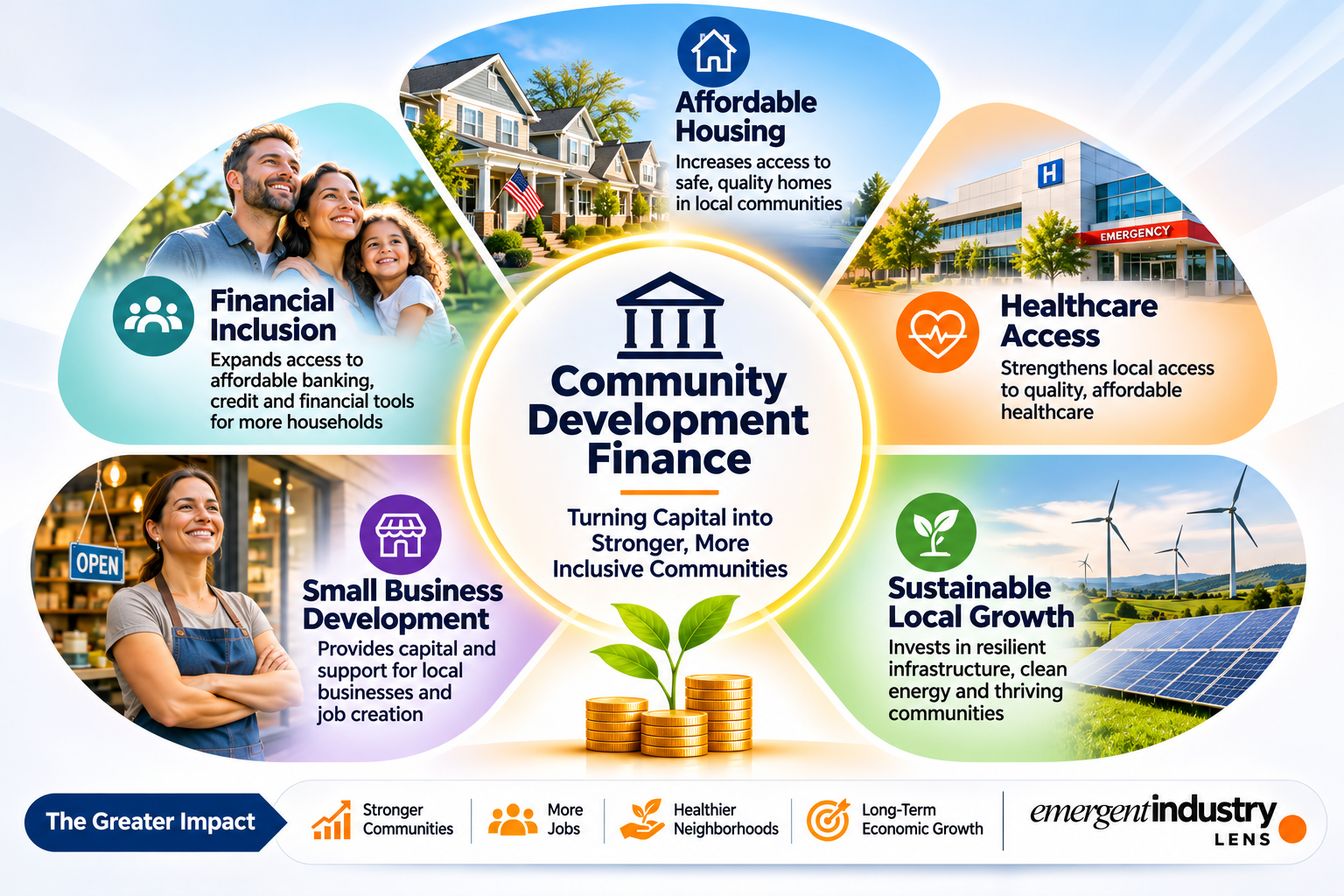
From strengthening community lenders to financing affordable homes and connecting housing with healthcare, America’s banking industry is expanding its role in economic development. A growing number of initiatives from major financial institutions point towards an evolving model of banking one that connects commercial growth with the economic needs of communities.

For generations, banks have been central to economic growth by mobilising savings, extending credit and financing businesses. In the United States, however, financial institutions are increasingly directing capital towards areas that support the foundations of local economies: affordable housing, small businesses, community infrastructure and access to essential services.
This shift is taking place against a backdrop of housing affordability challenges, uneven access to credit and barriers to entrepreneurship. Government programmes and nonprofit organisations have traditionally played important roles in addressing these gaps. Commercial banks are now becoming more active partners, bringing their financial resources, lending expertise and institutional networks into community development.
Recent initiatives from Capital One, JPMorganChase and Bank of America illustrate three interconnected dimensions of this evolving approach. Strengthening the institutions that provide community finance, expanding affordable housing supply and supporting developments that connect residential stability with essential services.
These investments are not necessarily acts of philanthropy. They also represent opportunities for financial institutions to reach new markets, develop lending relationships and build long-term commercial partnerships. Their wider significance lies in how these business opportunities can coincide with economic benefits for communities.
Strengthening the financial foundations of underserved communities
Access to capital is often one of the biggest obstacles facing small businesses and community development projects. Entrepreneurs operating in low-income neighbourhoods, for example, may struggle to secure affordable financing because they lack collateral, established credit histories or access to conventional lending networks.
Community Development Financial Institutions (CDFIs) help bridge this gap. These specialised financial organisations provide loans and financial services to businesses, individuals and communities that may have limited access to traditional banking.
Recognising the importance of these institutions, Capital One and the National Association for Latino Community Asset Builders (NALCAB) expanded their longstanding partnership in September 2026. The initiative combines a US$2 million, five-year lending facility with US$6.4 million in philanthropic support and specialised professional assistance.
Through NALCAB’s network of more than 200 nonprofit lenders and community development organisations, the investment will support small-business growth, affordable housing, mixed-use commercial developments and community facilities. It will also strengthen the operational capabilities of community lenders through improved data infrastructure, risk management, leadership development and technical assistance.
The underlying strategy is to strengthen the organisations that already have relationships with local borrowers and understand the financial needs of their communities.
” CDFIs possess the unique, on-the-ground expertise needed to deploy capital down and into communities,” said Kerone Vatel, Senior Vice President and Head of Community Finance, Impact & Investment at Capital One, in the September 24 announcement.
NALCAB President and CEO Marla Bilonick highlighted the commercial and economic importance of removing financing barriers, noting that small businesses and community organisations are vital drivers of economic growth but continue to face challenges accessing affordable capital.
For Capital One, the arrangement also creates a route to support a wider community lending ecosystem through an established intermediary rather than relying exclusively on direct lending. For smaller lenders, access to capital, expertise and stronger operating systems can improve their ability to finance local businesses and development projects.
But access to finance is only one part of the challenge. For communities to prosper, investment must also reach the essential infrastructure that supports everyday life. Affordable housing is one of the most important areas where this relationship becomes visible.
Affordable housing emerges as a strategic banking priority
Housing affordability has become a significant economic concern across the United States. Rising property costs, limited housing supply and increasing rental pressures have made it difficult for many households to secure stable accommodation or achieve homeownership.
For financial institutions, addressing this challenge increasingly involves looking beyond conventional mortgage lending and supporting the broader housing ecosystem.
JPMorganChase is taking this approach through its American Dream Initiative, which it expanded in August 2026. The bank intends to deploy more than US$750 billion through 2035 towards increasing housing supply and supporting homeownership. Its ambitions include financing the construction or preservation of one million affordable housing units and helping 500,000 customers purchase homes, including 200,000 first-time homebuyers.
The initiative combines financing with policy engagement and collaboration across the real estate ecosystem. The bank intends to work with developers, nonprofit organisations and policymakers on issues such as zoning, building codes, permitting and public-private partnerships.
For JPMorganChase, housing is not simply a real estate investment category; it is an important contributor to economic stability and opportunity.
“An affordable and resilient housing market is essential to driving economic growth and increasing opportunity,” said Michelle Herrick, Head of Commercial Real Estate at J.P. Morgan, in the bank’s August 3, 2026 announcement.
Sean Grzebin, CEO of Chase Home Lending, highlighted the broader value of homeownership stating, “Homeownership has always been at the heart of the American Dream. Owning a home can transform lives—providing stability, helping families build wealth, and creating a sense of community.”
The economic implications extend beyond individual homeowners. Stable housing can support workforce participation, strengthen household finances and help families build long-term financial security. It can also help employers retain workers and enable communities to remain economically active.
JPMorganChase also recognises that financing alone cannot solve the housing shortage. Increasing supply requires coordinated action across financial institutions, developers and government agencies. By combining capital deployment with policy engagement, the bank is seeking to address both the financial and structural barriers to affordable housing.
While JPMorganChase is setting long-term housing ambitions, Bank of America offers another perspective on how housing investments can connect with wider community needs.
Connecting housing with healthcare and community well-being
The relationship between housing and economic opportunity extends beyond homeownership. Stable accommodation can influence physical health, financial security and the ability of families to participate fully in their communities.
Bank of America is incorporating this wider perspective into its community development financing.
In February 2026, the bank’s Community Development Banking division reported that it had provided US$7.4 billion in debt and equity financing during 2025. The funding supported 87 developments across 68 cities in 21 states, representing more than 11,000 affordable housing units.
Since 2020, the bank has provided more than US$42 billion in financing, supporting the creation and preservation of over 74,000 housing units across 335 cities in 40 states.
Beyond the scale of its housing investments, another aspect of the programme deserves attention: the integration of healthcare components into some affordable housing developments. In 2025, 39 developments, representing approximately 3,700 housing units, included a healthcare component.
These projects may incorporate or provide access to services such as primary and preventive care, health and wellness education and supportive services. The idea is to bring essential services closer to residential communities, making them more accessible to people who might otherwise face practical barriers to obtaining care.
This is an important distinction. The bank is not simply financing residential buildings; it is supporting developments where housing is connected with services that contribute to residents’ well-being.
“When we talk about affordable housing, we’re talking about the foundation for a better future,” said Maria Barry, National Executive of Community Development Banking at Bank of America, in the bank’s February 12, 2026 announcement.
Barry also emphasised the importance of working with experienced developers and local and state agencies to meet community needs and strengthen neighbourhoods over the long term.
The approach reflects a broader understanding of community development. Affordable housing, healthcare access, employment and household financial stability are interconnected aspects of quality of life. For financial institutions, supporting developments that bring some of these elements together can also create opportunities to finance more comprehensive community infrastructure.
A more collaborative model of community development finance
Taken together, the initiatives from Capital One, JPMorganChase and Bank of America reveal a common direction, even though their approaches differ.
Capital One is strengthening the community lending ecosystem. JPMorganChase is mobilising capital and policy partnerships to address housing affordability. Bank of America is demonstrating how housing finance can connect with broader community services.
These approaches are complementary. Community lenders help make capital accessible to smaller organisations and entrepreneurs. Housing finance supports the development of essential infrastructure. Integrated community investments can improve the conditions in which families and businesses operate.
The role of Community Development Financial Institutions is particularly important in this model. These organisations often work with borrowers and communities that conventional lenders may find difficult to serve. Partnerships with commercial banks can provide them with additional capital, expertise and institutional support.
For banks, such arrangements can open access to new lending opportunities, strengthen local relationships and extend their reach through established community networks. For communities, they can mean better access to financing, more affordable homes and improved essential services.
However, the long-term success of these initiatives will depend on execution. Announced commitments must translate into completed housing projects, sustainable lending programmes, viable businesses and measurable improvements in community well-being.
Financial inclusion across Asia: Expanding markets while supporting local economies
The commercial logic behind these initiatives is not unique to the United States. Across South and Southeast Asia, financial institutions have been exploring ways to serve households, entrepreneurs and small businesses that have traditionally had limited access to formal credit.
India’s consumer finance market offers one example. Companies such as Bajaj Finance have built extensive point-of-sale lending networks that allow consumers to purchase white goods, electronics and other household products through instalment-based financing.
This is consumer-durable financing rather than microfinance in the conventional sense. However, the underlying business model is instructive. Financing can unlock consumer demand, bring new customers into the formal credit ecosystem and create recurring relationships between lenders, retailers and consumers.
The company’s commercial ambition is equally evident in its customer acquisition strategy. In its FY2024–25 Annual Report, Sanjiv Bajaj, Chairman of Bajaj Finance, outlined the company’s goal of acquiring the next 100 million customers through strategic partnerships and organic acquisition channels. This ambition highlights how consumer financing can serve as a growth engine for lenders, expanding their customer base while making higher-value household purchases more accessible to consumers.
A different but related model operates through microfinance institutions across Asia. These organisations provide smaller loans to households, micro-enterprises and local entrepreneurs, often reaching borrowers who may not qualify for conventional bank credit.
Commercial banks and other financial institutions participate in this ecosystem by providing funding to microfinance institutions, sometimes through risk-sharing arrangements with development finance organisations.
The Asian Development Bank’s Microfinance Program provides a useful illustration. Its programme partners include financial institutions such as Standard Chartered, Citi, HSBC and Maybank, alongside other banks, wholesale lenders and microfinance organisations. Rather than requiring commercial banks to build their own extensive last-mile lending networks, this model enables capital to flow through specialised institutions with established relationships in local markets.
The programme operates across several developing economies, including Bangladesh, Cambodia, Indonesia, Myanmar, Nepal, Pakistan and the Philippines, as well as markets in Central and West Asia. According to the ADB’s 2025 Partnership Report, the programme channelled US$433 million to microfinance institutions and partner finance institutions during 2025, of which US$217 million was mobilised. This supported more than 800,000 beneficiaries. Since its launch, the programme has supported almost 13 million beneficiaries through its partnerships.
In the Philippines, the Asian Development Bank’s partnership with the Center for Agriculture and Rural Development (CARD Inc.) has helped expand access to microfinance for women entrepreneurs and small-business owners.The role of microfinance institutions extend beyond simply distributing loans. CARD Inc. combines credit with savings, insurance, education and health services, while tailoring repayment schedules and financial products to borrowers’ circumstances. Its Executive Director, Vicente Briones Jr., has emphasised the importance of understanding borrowers’ economic conditions so that lending products and repayment arrangements reflect their actual capabilities.
Such models illustrate how financing can create value at multiple levels. Financial institutions gain access to new lending markets, microfinance providers expand their reach, entrepreneurs gain working capital, and households can strengthen their income-generating capacity. The wider community can benefit when these businesses sustain operations, serve local demand and create employment.
The community impact of this financing can extend beyond individual borrowers. A small loan can help a neighbourhood retailer purchase inventory, enable a rural entrepreneur to invest in equipment, or provide working capital to a family-run business looking to expand. As these enterprises grow, they can create employment, serve local demand and contribute to economic activity within their communities.
This illustrates an important overlap between commercial opportunity and community development. For lenders, extending credit to previously underserved segments can create new markets and long-term customer relationships. For communities, access to appropriately structured finance can support livelihoods, household stability and small-business growth.
However, expanding access to credit does not automatically translate into positive outcomes. Responsible lending, transparent pricing, appropriate loan structures and realistic repayment terms are essential to ensure that borrowers benefit from financing rather than become burdened by debt.
Whether through community development finance in the US, consumer lending in India or microfinance across Asia, the broader opportunity lies in connecting capital with unmet economic demand. The institutions that do this sustainably can expand their businesses while supporting wider economic participation.
Community Development: A Commercial Opportunity as Well as a Social Imperative
The developments across the US and Asian financial services markets point towards an evolving approach to financial inclusion and community development. While the business models differ, the underlying opportunity is similar: reaching households, entrepreneurs and businesses that have historically had limited access to formal financial services.
For banks and financial institutions, these segments represent potential markets for lending, deposits, payments and other financial products. Partnerships with CDFIs, microfinance institutions, developers and nonprofit organisations also provide access to local expertise and established distribution networks.
For communities, the benefits can extend beyond access to credit. Financing can support small-business expansion, create employment, improve access to housing and essential services, and strengthen local economic activity. However, these outcomes are not automatic. They depend on responsible lending, transparent pricing, appropriate financing structures and the ability of borrowers to repay sustainably.
The next phase of financial inclusion will depend on how effectively commercial institutions balance these opportunities with the needs of the communities they serve. The challenge is not to choose between profitability and social impact, but to build financial models in which both can be sustained.
Ultimately, the future of community-focused banking may lie in recognising that underserved markets are not simply opportunities for lending growth. They are also opportunities to support entrepreneurship, strengthen local economies and expand meaningful participation in the financial system.
Editorial Disclaimer
This article is intended for general informational and educational purposes only. The views, observations and analysis presented are based on publicly available information, company announcements, official publications, industry reports and other sources available at the time of writing.Emergent Industry Lens is an independent industry publication. References to financial institutions, companies, organisations, executives and their initiatives are made for editorial and informational purposes and do not imply any affiliation, partnership, sponsorship or endorsement by the organisations mentioned.
Photographs, executive portraits, company logos and other visual assets used in this article may be sourced from publicly accessible websites, official company publications, press releases and other publicly available sources. All trademarks, logos, photographs and associated intellectual property remain the property of their respective owners. Their use is intended solely for editorial identification and illustrative purposes and does not imply endorsement of this publication. Appropriate source attribution is provided wherever available.While reasonable efforts have been made to verify the information and represent the initiatives accurately, readers are encouraged to refer to the original company announcements and official sources for the latest details. Announced commitments, financing targets and proposed investments should not be interpreted as amounts already deployed unless explicitly stated. Nothing in this article constitutes financial, investment, legal or business advice.