
The completed merger of Spain’s Veridas and the Netherlands’ Fourthline brings together two European identity technology specialists. Backed by up to €65 million in financing, the deal comes as banks face rising fraud risks, fragmented compliance systems and a major shift in Europe’s digital identity framework.
On 3 November 2026, Amsterdam-based Fourthline and Spain’s Veridas confirmed the completion of their merger, bringing together two companies working across identity verification, biometrics, compliance and fraud prevention.
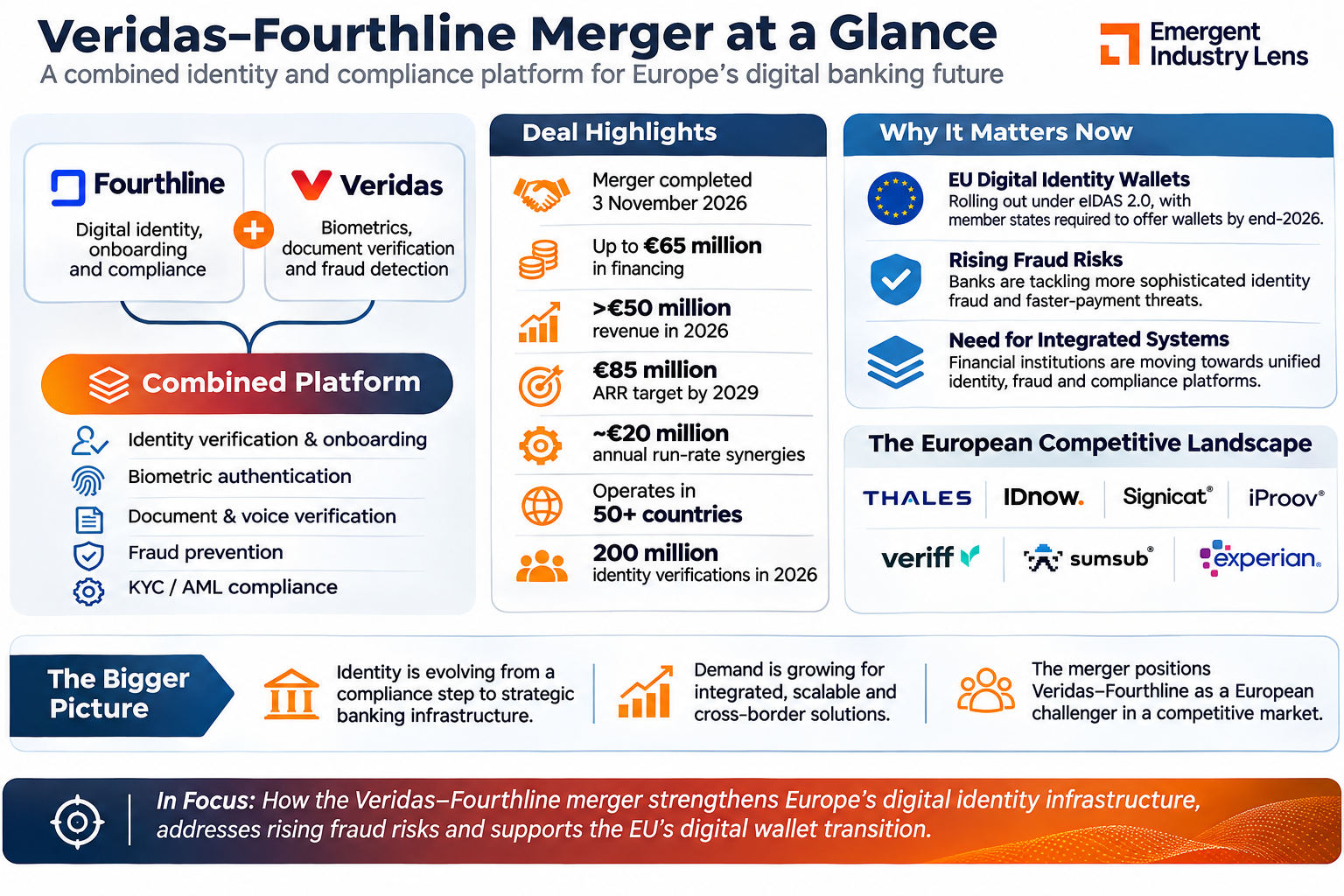
First announced in July, the transaction is backed by up to €65 million in financing from existing investor Finch Capital, new investor Seaya Andromeda and debt provider Ashgrove Capital. The combined business expects revenue of more than €50 million in 2026 and is targeting €85 million in annual recurring revenue by 2029.
The timing is significant. European financial institutions are preparing for new digital identity requirements even as fraudsters exploit faster payments, synthetic identities and increasingly sophisticated impersonation techniques.
For Fourthline and Veridas, the opportunity is to combine complementary technologies and expand their customer relationships. For the wider industry, the transaction offers a glimpse into how Europe’s digital identity market may evolve and who could emerge as its leading technology providers.
A merger built around complementary capabilities
The two companies are not simply combining similar products. Their technology and geographic strengths have developed in different markets.
Founded in Amsterdam in 2017, Fourthline built its business around digital onboarding, identity verification and compliance technology for regulated financial services. Its customer base includes financial technology companies and banks such as Revolut, N26, Trade Republic, Qonto, Scalable Capital, Raisin, Rabobank and Bitpanda.
Veridas, founded in 2017 as a joint venture with BBVA, developed expertise in biometric identity verification, document authentication and voice technology. It serves clients across banking, insurance, telecommunications and public administration.
The combined platform is intended to bring Fourthline’s compliance and decision-making capabilities together with Veridas’s biometric, document and voice technology. The companies say it will operate across more than 50 countries and is on track to process 200 million identity verifications in 2026.
The commercial logic is straightforward. Each business can introduce the other’s technology to its existing customers. The companies have indicated that customer overlap is limited, making cross-selling a central part of the growth plan.
According to the official merger announcement, the combination is expected to generate approximately €20 million in annual run-rate synergies. Both businesses were EBITDA-positive at closing.
The financial bet! Scale, cross-selling, and growth
The financing package of up to €65 million gives the combined company room to pursue more than operational integration.
The capital will support product development, potential acquisitions, debt refinancing and a shareholding reorganisation that includes partial liquidity for Veridas shareholders. The involvement of Seaya Andromeda adds a new equity investor, while Finch Capital remains a significant backer.
The growth targets are ambitious. The company expects more than €50 million in revenue in 2026 and aims to reach €85 million in annual recurring revenue by 2029.
These figures suggest that investors see an opportunity to build a larger European identity technology provider with the reach to compete across multiple regulated markets.
But the targets also set a clear test for the merger. Combining technologies and customer relationships is one thing; integrating platforms, retaining customers and delivering the projected synergies is another. The next phase will show whether the group can turn its expanded portfolio into a coherent commercial proposition.
Finch Capital’s transaction announcement outlines the funding structure, financial targets and expected synergies. Seaya Andromeda’s investment announcement provides further detail on the investor’s rationale.
Europe’s digital identity market is getting bigger and more competitive
The Veridas–Fourthline merger is taking place in a market that is attracting established technology groups, specialist identity providers and financial crime technology companies.
The opportunity extends well beyond bank account opening. Identity verification is increasingly used for customer onboarding, account recovery, payment authentication, fraud investigation and ongoing compliance.
According to Juniper Research’s May 2026 study, global spending on digital identity verification is forecast to rise from $18.8 billion in 2026 to $29 billion by 2030. Its research also identifies LexisNexis Risk Solutions, Experian and Thales as leading vendors in the global market.
Europe has its own mix of established players and specialist providers. France’s Thales and Germany’s IDnow represent different parts of the identity and authentication ecosystem. Norway’s Signicat has built a strong position around digital identity and electronic identity schemes. The UK’s iProov focuses on biometric verification, while Estonia’s Veriff and the UK’s Sumsub compete in identity verification and fraud prevention.
Larger international providers including Experian, LexisNexis Risk Solutions, Jumio and Entrust also compete for enterprise identity and financial services business.
These companies do not all offer identical propositions. Some bring extensive data assets and fraud intelligence; others specialise in biometric authentication, digital identity infrastructure, document verification or customer onboarding workflows.
That diversity matters. Banks are not choosing between a handful of interchangeable identity tools. They are evaluating technology providers across a range of requirements, from regulatory compliance and fraud detection to customer experience, geographic coverage and integration with legacy systems.
The Juniper Research findings also point to a change in how providers compete. The advantage is increasingly shifting from offering one verification method to connecting multiple sources of identity and risk information into a single decision-making process.
For the newly combined Veridas and Fourthline, this is the competitive environment in which the company must establish its position. Its European roots, existing financial services relationships and combined technology portfolio could be advantages. However, it will be competing against companies with significantly larger global footprints and established enterprise relationships.
Europe’s digital identity wallet rollout adds another dimension
The merger comes as the European Union moves towards a new model for digital identity.
Under the revised eIDAS framework, member states are required to make at least one European Digital Identity Wallet available to citizens, residents and businesses by the end of 2026. The wallets are intended to let individuals prove their identity and share verified credentials when accessing public and private services, including banking.
The framework is designed to make identity credentials more portable across borders while giving individuals greater control over what information they disclose.
Importantly, the wallets are not intended to replace every existing identity verification system. The European Commission says they will complement solutions already offered by banks and other service providers. Private service providers will also be required to accept the wallets for certain strong customer authentication purposes by the end of 2027.
The European Commission’s Digital Identity framework sets out the regulatory direction, while its wallet implementation guidance explains how the wallets are expected to work alongside existing national identity systems.
For identity technology providers, this creates a new set of questions. How will their systems authenticate wallet-based credentials? Can they integrate government-issued identity attributes into existing onboarding processes? And what role will commercial providers play when customers increasingly have access to reusable digital credentials?
The answers could influence the next generation of identity products and partnerships across the European financial services market.
The fraud problem banks still have to solve
Regulatory change is only one part of the story. European banks are also facing an operational problem. The systems used to manage identity, payments, fraud and compliance often do not communicate effectively.
A September 2026 study by Sumsub found that only 18% of surveyed financial institutions had fully integrated identity, fraud, payment and anti-money-laundering data in real time. Just 9% reported having an integrated platform across fraud and compliance functions.
The findings are particularly relevant as euro instant payments are expected to clear within ten seconds under the EU’s Instant Payments Regulation. Financial institutions have less time to identify suspicious transactions and intervene.
The research found that fraud is frequently detected at account access or payment initiation rather than during initial onboarding. In some cases, suspicious activity is identified only after a payment has settled or a customer has raised a complaint.
This exposes a gap between verifying a customer’s identity when an account is opened and monitoring the risks associated with that account over time.
The distinction is important for technology providers. A successful onboarding check does not guarantee that subsequent account activity is legitimate. Banks increasingly need connected systems that can assess identity, transaction behaviour and risk together.
The Veridas–Fourthline combination is positioning itself in this broader market, where identity verification is one part of a larger financial crime and compliance infrastructure.
Digital identity is becoming strategic banking infrastructure
For years, identity verification was often treated as a necessary step in customer onboarding a compliance requirement to be completed before a customer could access financial services.
That view is becoming harder to sustain.
As banking moves across mobile applications, digital wallets, instant payments and cross-border services, the ability to establish and maintain confidence in a customer’s identity affects more than regulatory compliance. It influences customer acquisition, fraud losses, operational costs and the speed at which financial institutions can introduce new services.
The competitive advantage will not necessarily belong to the provider with the most biometric features or the largest database. It may belong to the company that can connect identity credentials, verification, fraud signals and compliance decisions across the customer lifecycle.
This is also why the market’s competitive landscape matters. European providers are competing not only with one another, but with global technology companies that have the resources, data and established relationships to serve large financial institutions.
For European banks, the choice of provider will increasingly involve questions of resilience, data governance, interoperability and control over critical infrastructure not simply the accuracy of a face match or the speed of a document check.
What happens next?
The immediate task for the combined company is integration. Fourthline CEO Paul Stoddart will lead the group, while Veridas CEO Eduardo Azanza becomes its President. Amsterdam will serve as headquarters, with offices including Stockholm, Pamplona, Barcelona, Mexico, São Paulo and Boston.
The companies say existing contracts, integrations and local support will continue, with platform integration taking place in phases. Customers are not required to take immediate action.
Beyond the organisational transition, three developments will be worth watching. Whether the company can deliver the projected €20 million in annual synergies; whether cross-selling drives meaningful growth across its customer base; and how effectively its platform adapts to Europe’s emerging digital identity wallet ecosystem.
The Veridas–Fourthline merger is one transaction, not proof that the entire European identity market is consolidating. But it offers a revealing view of where investors and technology providers believe the market is heading.
The next phase of competition will be shaped by the ability to combine trusted identity credentials, real-time risk intelligence and regulatory adaptability. For Veridas and Fourthline, the opportunity is substantial. Whether the merger creates a genuine European challenger to the established global providers will depend on execution, customer adoption and the company’s ability to turn its combined technology into a distinctive market proposition.