
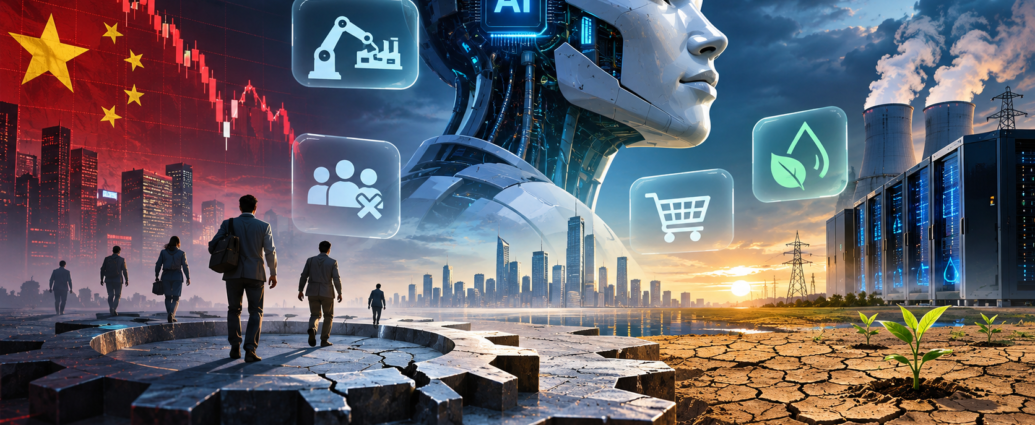
China’s AI market correction may be a warning about more than inflated valuations. As businesses race to automate and autonomous enterprises move closer to reality, a more fundamental question is emerging: can an economy built around continuous productivity growth adapt when technology begins to challenge the traditional relationship between work, income and consumption?
China’s AI correction: A reality check for the global technology boom
For much of the past two years, artificial intelligence has been treated as an almost unstoppable investment opportunity. Technology companies, semiconductor manufacturers, cloud providers and investors have placed enormous bets on a future in which AI transforms industries, accelerates productivity and creates entirely new markets.
Then came a reality check in China.
In an October 26, 2026 report, Reuters described how China’s AI and semiconductor stock rally had unravelled. China’s STAR 50 index had fallen around 40% in less than four months, wiping out approximately US$480 billion in market value.
A subsequent Channel NewsAsia analysis on October 29 examined what the correction could mean for China’s AI ambitions and the wider technology industry.
The sell-off does not necessarily signal a failure of AI technology. It points instead to a growing gap between technological progress, investor expectations and commercial returns.
Building powerful models is one challenge. Turning them into sustainable businesses is another. AI companies must contend with high computing costs, intense competition, falling prices for model access and uncertainty over how quickly customers will pay for increasingly sophisticated capabilities.
The distinction is important because the AI industry is entering a phase in which technological leadership alone may not guarantee financial success.
China’s experience also offers a lesson for global markets: the long-term value of AI will depend not only on what the technology can do, but on whether the economics of developing, deploying and operating it make sense.
And that brings us to a question that extends well beyond stock markets: what happens when the technology becomes capable of doing an increasingly large share of the work traditionally performed by people?
The AI Layoff Trap: When individual business decisions create a collective problem
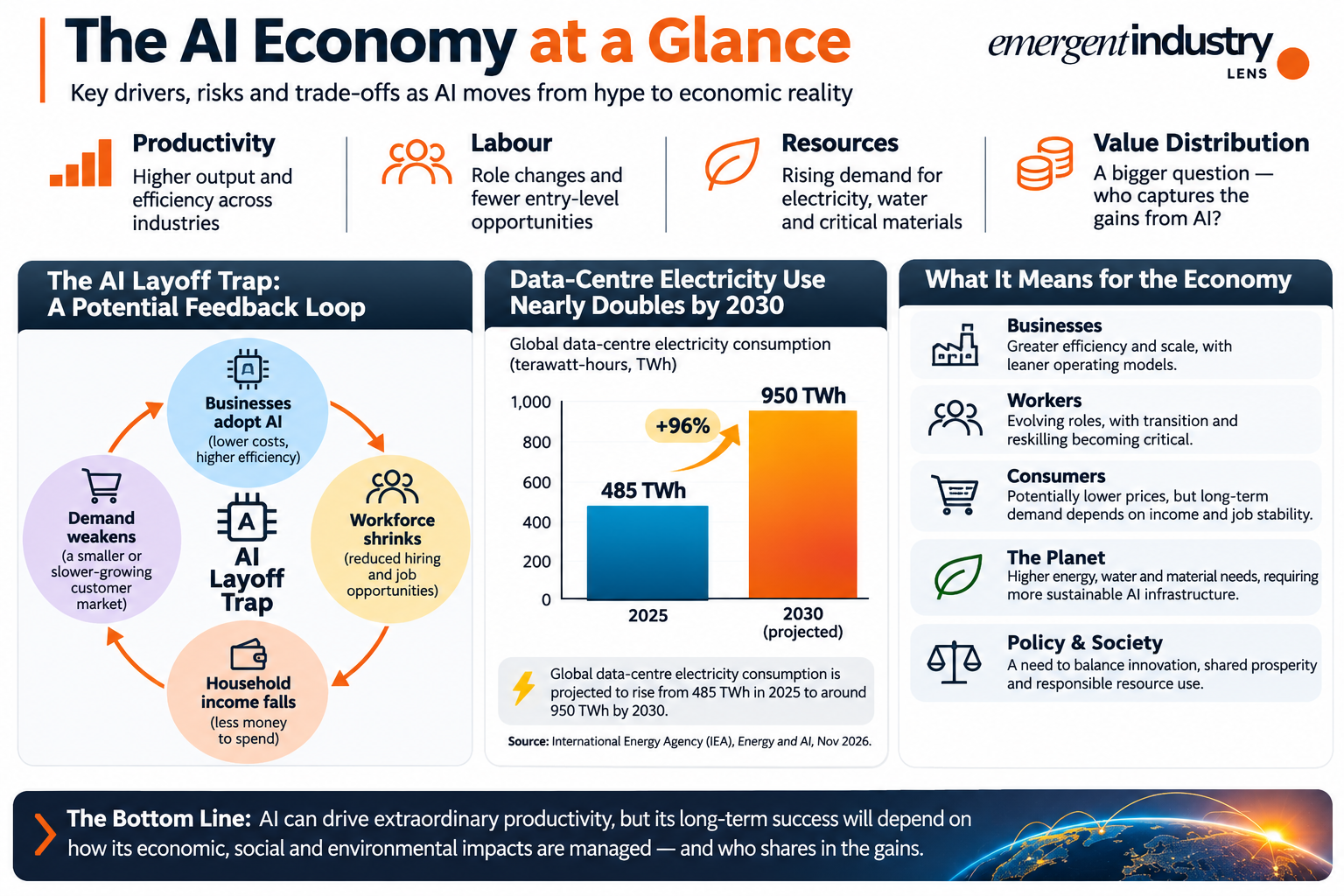
In March 2026, researchers Brett Hemenway Falk and Gerry Tsoukalas published a paper titled The AI Layoff Trap.
Their research examines a potentially damaging consequence of widespread automation: companies may collectively automate more jobs than is economically beneficial, even when each individual company is making a rational business decision.
Consider a company that introduces AI to reduce its workforce. Its operating costs fall, productivity improves and profits may increase. From the company’s perspective, automation is a competitive advantage.
But the workers displaced by automation are also consumers. Their lost income affects spending on housing, transport, food, healthcare, education and other products and services.
When many companies follow the same strategy, the consequences extend beyond individual workplaces. The collective reduction in labour income can weaken demand across the economy.
This is the central mechanism behind the AI Layoff Trap. Each business captures the benefits of reducing its own labour costs, while some of the economic consequences are borne by the wider market.
The research is based on an economic model, not a prediction that mass unemployment is inevitable. Its significance lies in highlighting a problem that conventional corporate cost calculations may overlook: businesses depend on the purchasing power of the broader economy, not just their own operational efficiency.
The issue was brought to a wider audience in a BBC Global interview with Professor Gerry Tsoukalas, presented by Katty Kay. The discussion explored the possibility that companies could enter a race to automate, even if the cumulative effect undermines the economic conditions on which they depend.
It raises a difficult question for business leaders. If automation becomes a competitive necessity for every company, who takes responsibility for the consequences when the labour market changes faster than the economy can adapt?
The autonomous enterprise is changing the organisation of work
The next phase of AI adoption may not be about giving employees another productivity tool. It may be about redesigning entire organisations around autonomous systems.
Agentic AI is moving beyond isolated chatbots and content-generation applications. AI agents can be designed to execute multi-step tasks, interact with software systems, retrieve information, coordinate workflows and work towards defined objectives.
Imagine a business in which,
- AI agents identify potential customers, research accounts and prepare sales outreach.
- Marketing systems generate, personalise and optimise campaigns.
- Procurement systems compare suppliers, monitor prices and initiate purchase workflows.
- Customer service agents resolve routine queries and escalate complex cases.
- Finance systems reconcile transactions, flag anomalies and prepare reports.
- Supply-chain systems monitor inventory and recommend adjustments.
These capabilities already exist in varying degrees of automation. The emerging development is the integration of multiple agents into connected workflows, reducing the need for human intervention at every stage.
An autonomous enterprise would not necessarily mean a company without people. Strategic decisions, accountability, governance, regulatory obligations, relationships and exceptions will continue to require human judgement. The degree of autonomy will also differ across sectors, particularly where mistakes carry significant financial, safety or legal consequences.
Nevertheless, the organisational model could change substantially.
Instead of expanding departments in proportion to revenue, businesses may increasingly scale through software, computing capacity and AI agents. A company could potentially manage more customers, transactions and operational complexity without increasing its workforce at the same rate.
For investors, this could represent a significant improvement in operating leverage. For employees, it raises questions about the future of career progression, particularly in roles that have traditionally provided entry-level experience.
Employment: Early warning signs, but no global verdict yet
It would be premature to declare that AI has already triggered a global employment crisis. The available evidence is more nuanced.
A Stanford Digital Economy Lab study examined payroll data covering millions of US workers through June 2026.
The researchers found no evidence of widespread, economy-wide job displacement. However, employment among workers aged 22–25 in occupations highly exposed to AI was 19% below the level it might have reached had it kept pace with less-exposed peers. The gap was primarily associated with reduced hiring rather than increased separations.
The findings are an early signal, not definitive proof that AI alone caused the employment difference.
This distinction matters. Technology can replace certain tasks, complement others and create demand for new capabilities. The impact depends on the nature of the work, the speed of adoption and the ability of workers and institutions to respond.
The IMF’s research on the global impact of AI also highlights the uneven distribution of potential benefits. Economies with stronger digital infrastructure, investment capacity and technological readiness may be better positioned to capture productivity gains than those with limited access to these capabilities.
The transition will therefore not look the same everywhere. Some industries may experience rapid restructuring, while others may see AI primarily augment existing roles. Countries with large service sectors, manufacturing bases or younger workforces may face very different opportunities and risks.
For employers, the challenge will be to distinguish between tasks that can be automated and capabilities that remain valuable when human expertise is combined with AI. For governments and education systems, it will be to ensure that the next generation is not locked out of the workforce because the traditional entry points into professional careers have changed.
The environmental bill behind artificial intelligence
Artificial intelligence may operate in the cloud, but the cloud is not weightless. Every model training run, inference request and autonomous workflow depends on data centres, semiconductor manufacturing, electricity networks, cooling systems, minerals and physical infrastructure.
As AI becomes embedded in business operations, the resources required to support it are becoming an increasingly important economic consideration.
The International Energy Agency’s analysis of energy and AI highlights the growing electricity requirements of data centres. AI-focused facilities can have particularly high power demands, and expansion is increasingly dependent on access to electricity, grid connections, transformers and new generation capacity.
The environmental impact extends beyond energy.
Water consumption is a growing concern. Data centres may use water for cooling, while electricity generation and semiconductor manufacturing also have significant water requirements. The impact varies according to cooling technology, local climate, electricity sources and the efficiency of individual facilities.
The Ceres report, Drained by Data, examines how data-centre expansion can intensify pressure on regional water supplies, particularly where infrastructure is concentrated in already water-stressed areas.
This has implications beyond the technology sector. Agriculture, households and industry all depend on reliable water supplies. Where new data centres compete with these users for limited resources, infrastructure expansion can intensify existing local pressures.
The connection to food security is indirect but important. Agriculture depends on water and affordable energy; food processing, refrigeration, storage and distribution depend on reliable power. Competition for these resources can add to the economic pressures facing agricultural communities and food systems.
It would be inaccurate to claim that AI is independently causing global food or water crises. Climate change, population growth, conflict, agricultural practices and inadequate infrastructure are much more established drivers. However, poorly planned data-centre development could compound resource stress in vulnerable regions.
There is also a minerals and manufacturing dimension. Semiconductor production and the construction of data-centre and power infrastructure depend on complex supply chains, specialised materials and energy-intensive industrial processes.
This raises a question that is often overlooked in discussions about AI productivity and how should the industry measure efficiency?
An AI system that saves thousands of working hours but requires substantial electricity, water and physical infrastructure should not be judged on labour productivity alone. Its environmental footprint must also be considered.
The long-term viability of the AI economy will depend partly on more efficient chips, improved cooling, responsible water management, cleaner electricity and better planning of infrastructure locations.
The technology may be digital. Its resource costs are not.
Who owns the productivity gains?
If AI substantially changes how businesses operate, it could also change the distribution of economic value.
The gains from automation may flow through several channels: higher corporate profits, lower prices, improved services, new products, increased investment and returns to the owners of technology and infrastructure.
How these gains are distributed will matter.
A worker whose productivity increases through AI may benefit through higher wages, better opportunities or reduced working hours. A business owner may benefit through improved margins. An investor may benefit from returns on capital.
But if productivity improvements primarily increase returns to capital while labour income loses ground, the distribution of economic gains could become more unequal.
This is not a new debate. Technological change has repeatedly shifted the balance between labour and capital. What makes AI different is the breadth of tasks it may affect, including some forms of analytical, administrative and creative work that were previously considered relatively insulated from automation.
The question is whether existing economic institutions can adapt to a world in which ownership of computing infrastructure, models, data and intellectual property becomes an even more important source of wealth.
Potential responses include broader ownership of capital, social dividends, income support, shorter working weeks and investment in new forms of employment. Each approach raises difficult questions about taxation, incentives, public finances and implementation.
There is no single solution. But the distribution of AI-generated wealth is likely to become a major economic and political issue as adoption deepens.
What happens to consumerism when work changes?
Modern consumer economies are built around a relatively familiar cycle. People work, earn income and spend it on goods and services. Businesses employ people, produce products and depend on customers to buy them.
AI could alter this relationship without eliminating the human need to consume.
People will continue to need food, housing, healthcare, education, transport, entertainment and social connection. What may change is how they earn the income required to access these things.
If automation reduces the need for human labour in significant parts of the economy, societies may have to reconsider the assumption that full-time employment is the primary route through which people participate in economic prosperity.
A future with higher productivity and shorter working weeks could be attractive if the gains are shared broadly. People might have more time for family, learning, creativity and leisure.
A future in which economic output rises while access to income becomes concentrated could look very different. It could produce greater material abundance alongside greater insecurity for households that do not own productive assets or have access to alternative sources of income.
This is why the debate about AI extends beyond employment statistics. It touches the foundations of mass consumerism and the social contract that supports modern capitalism.
The future of capitalism is an open question
The AI revolution could accelerate scientific discovery, improve healthcare, expand access to education, optimise supply chains and increase industrial productivity. It may also reshape the economics of work, ownership and consumption.
China’s market correction has exposed the gap between technological ambition and financial returns. The AI Layoff Trap has highlighted a possible weakness in the collective logic of automation. Autonomous enterprises could change the relationship between business growth and workforce expansion. Meanwhile, the environmental footprint of AI raises questions about the resources required to sustain its expansion.
These are connected challenges, but they are not the same problem. Each will require different responses from businesses, investors, policymakers and institutions.
The real test of the AI revolution will not be how many tasks machines can perform or how many employees companies can replace. It will be whether societies can translate technological capability into durable economic and social progress.
An economy can survive a stock market correction. It can adapt to new technologies and reorganise its industries. But it will need to rethink how people participate in prosperity if the relationship between work, income and production changes fundamentally.
The question for the next phase of capitalism is not simply whether machines can do more.
It is whether the economic system can ensure that the benefits of doing more are shared widely enough and produced sustainably enough to support the society those machines are meant to serve.
Disclaimer
This article is intended for informational, educational and editorial purposes only. It draws upon publicly available news reports, academic research, institutional publications and media discussions available at the time of writing. The views and scenarios discussed regarding AI-driven job displacement, autonomous enterprises, economic inequality, consumer demand and environmental pressures are analytical perspectives and potential outcomes, not established certainties or predictions. References to research papers and third-party media content are attributed to their respective authors and publishers. Emergent Industry Lens does not necessarily endorse every opinion or projection expressed in the cited sources. Readers are encouraged to consult the original sources and exercise independent judgement. The article does not constitute investment, financial, economic or policy advice.