
As artificial intelligence drives unprecedented investment in digital infrastructure, insurers are confronting a complex convergence of physical damage, power dependency, climate exposure and business interruption. The challenge is no longer simply insuring buildings and equipment. It is understanding how a failure in one part of the AI ecosystem can trigger losses across an interconnected network.
When a Cooling Failure Becomes a Business Crisis
Imagine a hyperscale data centre supporting AI applications for a global bank, a healthcare network and a logistics company. Thousands of high-performance computing chips operate inside the facility, generating enormous amounts of heat. Sophisticated cooling systems keep the equipment within operating limits, while backup power infrastructure is designed to maintain continuity.
Now imagine that a failure in the cooling system forces the facility to shut down.
The immediate damage may be limited to a particular section of the building. Yet the financial consequences could extend much further: computing capacity becomes unavailable, service-level commitments come under pressure, customers activate contingency arrangements, and dependent businesses face operational disruption.
The data centre operator may face property damage and business interruption claims. Customers may suffer losses of their own. Insurers must determine which policies respond, how contractual responsibilities are allocated and whether several claims arise from the same underlying event.
This is not merely a hypothetical insurance problem. In its August 2026 analysis, Allianz Commercial’s report on data centre construction risks highlighted claims involving external cooling-system damage, fire during construction work and delays caused by power disturbances. Individual cases resulted in losses ranging from US$50 million to US$100 million.
The broader lesson is that the insurance implications of AI infrastructure are growing alongside the technology itself.
From Server Buildings to Critical Infrastructure
For much of the digital economy’s history, data centres were primarily understood as specialised facilities housing servers, storage systems and networking equipment. Their insurance requirements focused on property damage, equipment breakdown, fire protection and the interruption of services.
The AI infrastructure boom is changing that risk profile.
Modern AI facilities are designed to support high-density computing workloads, with expensive graphics processing units (GPUs), complex electrical systems, advanced cooling technology, backup power and extensive network connectivity. A large campus may also depend on external substations, transmission infrastructure, water supplies, specialist contractors and globally distributed equipment suppliers.
The result is a concentration of value and operational dependency that is difficult to assess by looking at the building alone.
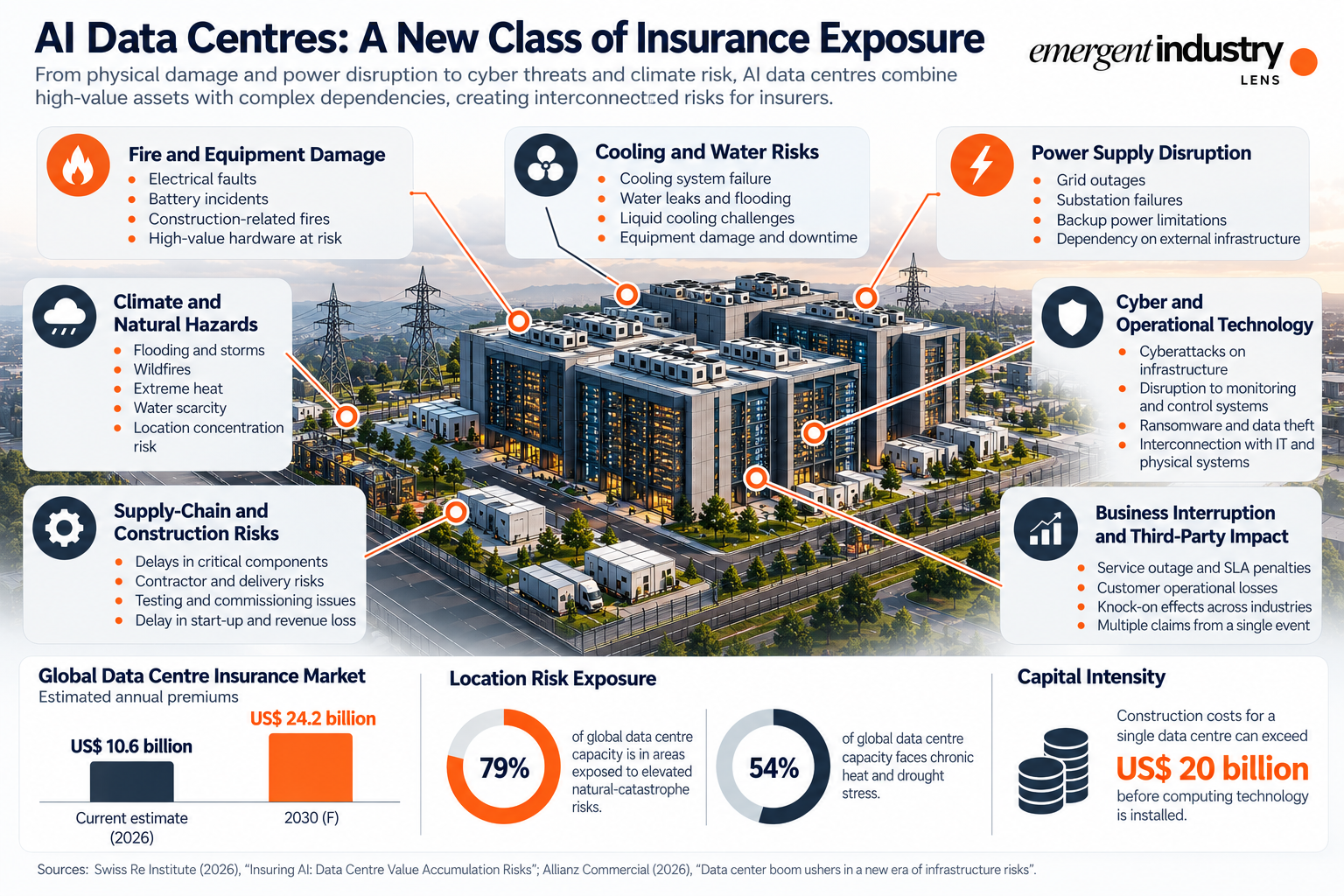
According to Swiss Re Institute’s March 2026 analysis, Insuring AI: Data Centre Value Accumulation Risks, construction costs for a single data centre project can reach US$20 billion before the full value of installed computing technology is included.
Swiss Re also estimated that global insurance premiums associated with data centres could rise from approximately US$10.6 billion to US$24.2 billion by 2030.
These figures point to two simultaneous developments: an expanding market for insurers and a growing concentration of potentially severe losses.
The distinction matters. More assets create more premium opportunities, but increasingly expensive facilities can also produce losses that are difficult to absorb or distribute through conventional insurance arrangements.
Five Risks Reshaping Data Centre Insurance
1. The physical risk of high-density computing
AI computing systems generate substantial heat and require tightly controlled operating conditions. Cooling technologies, electrical distribution systems, battery installations and backup power equipment introduce multiple points of potential failure.
Fire remains a particularly severe concern. Electrical faults, construction activities, battery incidents and failures in supporting equipment can threaten high-value assets within a concentrated area.
Water creates a different challenge. Liquid cooling is increasingly relevant for high-performance computing, but leaks or failures in cooling infrastructure can damage equipment and interrupt operations.
Allianz Commercial’s 2026 analysis of data centre-related insurance claims found that fire accounted for more than half of approximately €700 million in analysed losses. Water damage, meanwhile, was the most frequent cause of claims.
The difference between frequency and severity is important for underwriting. A relatively common water-damage incident may cause a limited loss in one facility, while a major fire can destroy high-value equipment and disrupt operations for an extended period.
For insurers, assessing the quality of fire suppression, electrical design, equipment separation, cooling controls and maintenance procedures is becoming as important as calculating the replacement value of the property.
2. Business interruption may matter more than the building itself
A data centre can suffer substantial financial consequences even when physical damage appears limited.
AI workloads increasingly support business-critical processes, from financial analytics and fraud detection to industrial planning, customer service and healthcare applications. When computing capacity becomes unavailable, the resulting losses may extend beyond the operator to customers, technology providers and other businesses dependent on the facility.
This creates a difficult insurance question: how should policies account for the financial consequences of a disruption that travels across several organisations?
Traditional business interruption cover generally depends on specific policy triggers and conditions, often including insured physical damage. Service interruptions without qualifying physical damage may be treated differently, depending on the wording and extensions purchased.
The issue becomes more complex when a failure originates outside the data centre. A grid disruption, damaged network connection or unavailable critical supplier may stop operations even when the insured building remains intact.
In its September 2026 guidance on data centre risk across the asset lifecycle, Marsh emphasised that exposures change as facilities move from planning and construction into live operations, upgrades and eventual decommissioning.
This makes business interruption analysis a lifecycle issue, not simply an exercise conducted when a policy is renewed.
3. Climate exposure is colliding with infrastructure concentration
Data centre development depends on a combination of land availability, electricity, network connectivity, planning approvals and access to cooling resources. These requirements can push projects towards locations where infrastructure is available but environmental risks may be significant.
Flooding can damage electrical equipment and prevent site access. Wildfires and storms can disrupt power and communications. Chronic heat can increase cooling requirements, while water scarcity can constrain operations and complicate expansion.
The geographical concentration of facilities adds another dimension. Multiple data centres, energy assets and network routes may be exposed to the same regional hazard.
Allianz Commercial’s 2026 assessment estimated that approximately 79% of global data centre capacity was located in areas exposed to elevated natural-catastrophe risks, while 54% faced chronic heat and drought stress.
These estimates underline the importance of distinguishing between the resilience of an individual facility and the resilience of the wider infrastructure network supporting it.
A building may be engineered to withstand a particular hazard, yet remain vulnerable if the surrounding power grid, water supply or telecommunications infrastructure fails.
Insurers will increasingly need to assess location-specific hazards alongside dependencies beyond the insured site.
4. Cyber risk extends into the physical infrastructure
AI data centres are not simply collections of computing equipment. They are connected operational environments in which software controls, monitoring systems, network access and physical infrastructure interact.
A cyber incident affecting operational technology could potentially interfere with monitoring, access controls or the operation of supporting systems. The consequences would depend on the systems affected, the security architecture and the ability to isolate compromised components.
This creates overlap between cyber insurance, property insurance, equipment breakdown and business interruption.
Policy boundaries are particularly important. A cyber policy may respond to specified digital events, while property and machinery policies may have exclusions or conditions relating to cyber-related damage. Coverage depends on the wording, applicable law and facts of the incident.
The challenge for insurers is not simply estimating the likelihood of a breach. It is understanding how a single digital event might affect physical assets, service availability and several insured parties.
For operators, cyber resilience must therefore extend beyond corporate IT systems to operational technology, supplier access, incident response and recovery procedures.
5. Supply-chain dependencies create risks before operations begin
The risks associated with AI infrastructure start long before a facility becomes operational.
Large projects depend on specialised electrical equipment, transformers, generators, cooling systems, networking hardware and high-performance computing components. Delays in any critical component can affect construction schedules and postpone the start of revenue generation.
The financial exposure can be considerable when a project involves substantial capital commitments, financing costs, contractual milestones and customer capacity reservations.
A completed building that cannot operate because a critical component is unavailable is not an economically productive asset.
This is why construction insurance and delay-in-start-up coverage deserve particular attention. Depending on the policy terms, delay-in-start-up insurance can help address lost anticipated revenue or other defined financial losses when insured physical damage delays the commencement of operations.
It will not necessarily cover every delay. Supply shortages, permitting issues and contractual disputes may fall outside the insured triggers.
Risk assessment must consequently include contractor performance, critical-component lead times, testing and commissioning, contingency arrangements and the allocation of responsibilities across project contracts.
The Accumulation Problem: When One Event Affects Many Policies
Perhaps the most difficult issue for the insurance industry is the potential accumulation of losses.
A major AI data centre campus may contain several buildings, multiple tenants, shared utilities and interconnected infrastructure. Different parties may insure different elements of the same ecosystem.
A single incident could generate claims under construction, property, equipment breakdown, business interruption, cyber and liability policies. If multiple facilities depend on the same grid, network provider or regional infrastructure, the impact could extend beyond one campus.
This creates a distinction between the value of individual insured assets and the concentration of risk across a portfolio.
Insurers and reinsurers must understand how exposures are distributed across locations, counterparties, suppliers and policy types. Otherwise, the apparent diversification of a portfolio may conceal common dependencies capable of generating correlated losses.
Swiss Re Institute’s analysis of data centre value accumulation identifies concentration risk across multiple insured parties and insurance lines as a significant challenge.
The implications extend to reinsurance, which allows insurers to transfer part of their exposure. Very large projects can require substantial limits, while the available capacity for particular risks may be constrained by insurers’ aggregate exposure, modelling uncertainty and the terms on which capital is available.
The question is no longer simply whether a project can obtain insurance. It is whether the coverage, limits, exclusions and retained risks accurately reflect the consequences of a major disruption.
Rethinking Underwriting for the AI Infrastructure Era
The changing risk landscape calls for a more integrated approach to underwriting.
First, insurers need a lifecycle view. A project should be assessed from site selection and construction through commissioning, operation, expansion and equipment replacement. Risk changes as the value and complexity of the asset increase.
Second, resilience must be measurable. Fire protection, cooling redundancy, power diversity, backup systems, cyber controls and disaster-recovery arrangements should be evaluated against credible failure scenarios rather than treated as generic compliance requirements.
Third, dependencies need to be mapped. Insurers should understand critical suppliers, grid connections, telecommunications routes, shared utilities, contractual commitments and the consequences of losing each dependency.
Fourth, business interruption requires deeper analysis. Revenue models, recovery times, customer concentration, service-level agreements and alternative computing capacity all influence the financial impact of an outage.
Finally, insurance programmes need to reflect the actual risk. Property, construction, engineering, cyber, liability and business interruption cover should be reviewed together, with particular attention to exclusions, sublimits, waiting periods and the interaction between policies.
Marsh’s data centre risk management guidance highlights the importance of assessing assets, revenue, contracts, supply chains and dependencies as part of a connected risk-management strategy.
No insurance programme can eliminate every exposure. However, a more complete understanding of the risk can help owners, lenders, operators and insurers make better-informed decisions about mitigation, financing and risk transfer.
A Global Challenge with Regional Consequences
The AI infrastructure expansion is increasingly global, but the risk profile differs from one market to another.
In the United States, the scale of investment and concentration of hyperscale facilities create substantial exposure to regional hazards and infrastructure dependencies. Europe must balance expansion with energy availability, planning constraints and climate resilience. Across Asia-Pacific, rapid capacity growth makes power infrastructure, water availability, local environmental conditions and supply-chain resilience particularly important.
According to Allianz Commercial’s August 2026 outlook, the United States and China are expected to account for approximately 62% of new global data centre capacity additions through 2030. The report also projects substantial expansion across Asia-Pacific markets outside China.
These differences mean there is no single insurance solution suitable for every market. Site selection, construction standards, regulatory requirements, local catastrophe exposure and access to insurance capacity will influence how individual projects are structured.
For global businesses, resilience planning must account for these regional differences while maintaining consistent standards for risk assessment and operational continuity.
Beyond Insurance: Resilience as a Competitive Advantage
The AI economy depends on infrastructure that can operate reliably at scale. Data centre developers compete not only on computing capacity and cost but also on their ability to deliver dependable services to customers with increasingly demanding operational requirements.
Insurance is becoming part of that equation.
A well-designed insurance programme can support financing and transfer defined risks. It cannot substitute for resilient engineering, effective maintenance, cyber security, contingency planning or reliable infrastructure.
The strongest operators will be those that integrate risk management into investment decisions from the beginning: selecting sites with a realistic understanding of environmental exposure, designing redundancy into critical systems, mapping dependencies and ensuring that contracts allocate responsibilities clearly.
For insurers, the opportunity is equally significant. The growth of AI infrastructure creates demand for sophisticated property and engineering cover, business interruption protection, cyber insurance and specialist risk advisory services. Meeting that demand will require more detailed exposure data, better accumulation modelling and closer collaboration with engineers, technology providers and infrastructure operators.
The Bottom Line
Artificial intelligence is creating a new generation of high-value infrastructure whose risks cannot be understood through traditional property insurance alone.
A failure in cooling, power, software or a critical supplier can affect more than a building. It can interrupt essential services, trigger contractual liabilities and generate losses across several organisations and insurance lines.
The industry’s challenge is to keep pace with the scale and interconnectedness of these investments. As AI infrastructure becomes more central to the global economy, the ability to measure, mitigate and finance its risks will be as important as the ability to build it.
The next phase of the AI boom will not be defined by computing capacity alone. It will also be defined by how resilient—and insurable—that capacity proves to be.
Editorial disclaimer: This article is for general information and industry analysis only. It does not constitute insurance, legal or financial advice. Coverage depends on individual policy wording, exclusions, conditions and applicable law. Market estimates and projections are attributed to the cited sources and may change.