
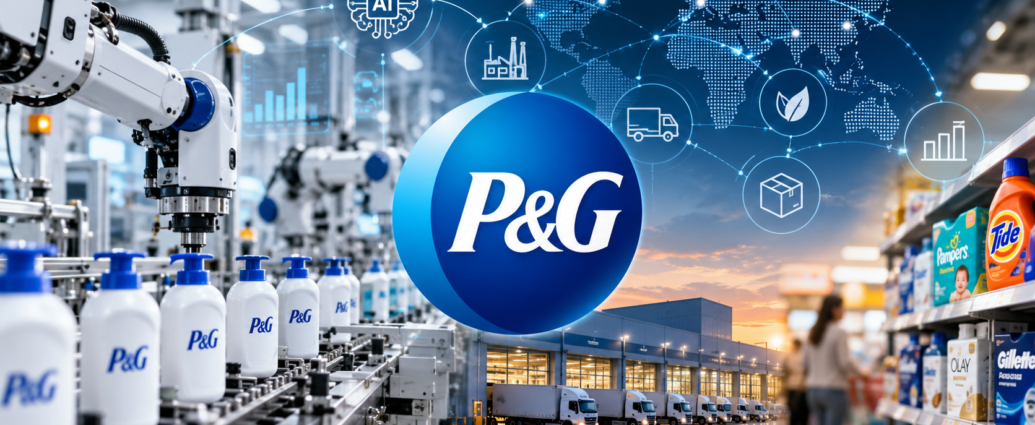
From touchless manufacturing to connected retail networks, Procter & Gamble is rethinking how everyday consumer products are made, moved and delivered.
Emergent Industry Lens | Manufacturing, Supply Chain & Digital Transformation
When a missing product becomes a business problem
A consumer walks into a supermarket expecting to find a familiar detergent. A parent places an online order for diapers, only to discover that the required size is unavailable. A retailer has customers ready to buy, but its shelves are empty because production schedules, warehouse inventory and replenishment systems have failed to align.
These seemingly ordinary situations expose a fundamental challenge in the fast-moving consumer goods (FMCG) industry. Producing a product at scale is no longer enough. Companies must also ensure that the right product reaches the right market, at the right time, with minimal waste and competitive economics.
For a multinational operating across product categories, markets and distribution channels, this requires far more than efficient factory operations. It demands coordination between consumer demand, procurement, manufacturing, inventory, logistics and retail.
Procter & Gamble’s October 2026 update on its Product Supply strategy offers a useful view of how one of the world’s largest consumer-goods companies is addressing this challenge. Its approach brings together connected data, automation, workforce development, retail collaboration and sustainability under a broader ambition to build a faster and more resilient supply chain.
The significance extends beyond P&G. Its transformation illustrates a wider shift in global FMCG. Operational efficiency is increasingly being built around connected decisions rather than isolated improvements to individual processes.
The business context: Growth requires more than selling more products
P&G’s latest annual results underline the economic environment in which this transformation is unfolding.
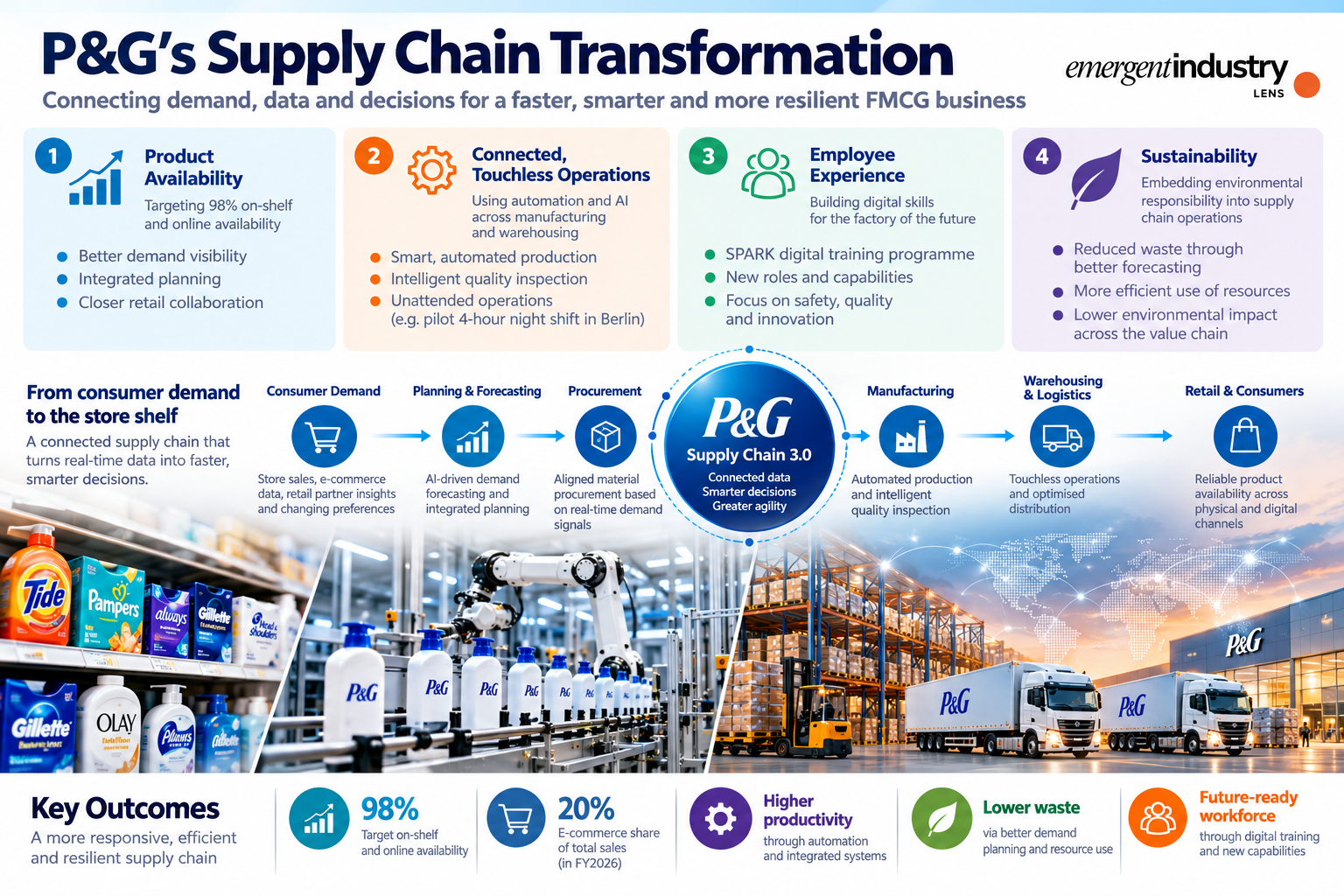
According to the company’s fiscal 2026 results, net sales reached $87 billion, up 3%, while organic sales grew 1%. Core earnings per share also increased 1%. The company reported that nine of its ten product categories held or grew organic sales, while e-commerce accounted for 20% of total company sales, following 6% growth in that channel.
These figures tell a nuanced story. P&G continues to generate substantial global revenue, but organic growth remains modest. Its performance also varies across product categories and markets, reinforcing the importance of disciplined execution.
For consumer-goods manufacturers, growth depends on several interconnected variables. Consumer preferences change, retailers demand reliable availability, product portfolios become more complex, and input costs can move unpredictably. Meanwhile, consumers increasingly expect products to be available across physical stores, online marketplaces and rapid-delivery channels.
A company may have strong brands and considerable distribution reach, yet still lose sales through inaccurate forecasts, excess inventory or stockouts.
This is why supply-chain transformation has become a strategic priority rather than a back-office exercise.
Supply Chain 3.0: Moving from disconnected processes to connected decisions
P&G’s Supply Chain 3.0 initiative seeks to integrate decisions across the movement of products, from customer orders and inventory management to production planning and material procurement.
In its May 2026 report on P&G’s supply-chain rollout, Supply Chain Dive reported that the company was scaling capabilities developed over several years. The initiative was designed to improve productivity through greater systems integration, automation and more coordinated planning across manufacturing and warehousing.
P&G has set a target of 98% on-shelf and online product availability. Its October strategy update describes how the company is connecting its systems more closely with those of retail partners so that teams can gain better visibility and make decisions faster.
The objective is to move beyond the traditional sequence in which sales forecasts are handed to planners, planners create production schedules, procurement orders materials, and logistics teams respond to the resulting requirements.
When these functions operate on disconnected information, a change in consumer demand can take too long to travel through the organisation. One team may continue producing against an outdated forecast while another is already dealing with excess inventory or a shortage.
A connected operating model can shorten these feedback loops. Updated demand signals can inform inventory requirements, production schedules and material orders, while greater visibility into retailer requirements can help manufacturers respond before a shortage reaches the shelf.
The competitive advantage lies not merely in having more data, but in making that data usable across the entire operating network.
Automation on the factory floor: Beyond replacing manual tasks
One of the more striking elements of P&G’s transformation is its work towards touchless manufacturing and warehouse operations.
According to Supply Chain Dive, P&G has been piloting a four-hour unattended night shift at its grooming plant in Berlin, Germany, as part of a broader set of automation pilots. The report also describes automated handling of finished products, packaging and raw materials in warehouse operations.
An unattended shift does not mean that manufacturing can operate without engineering, maintenance, safety systems or human oversight. Rather, it demonstrates the potential for selected operations to continue with minimal direct intervention when equipment, controls and production processes are sufficiently reliable.
The implications are significant.
In conventional manufacturing, employees may spend considerable time monitoring repetitive activities, coordinating handovers or responding to predictable operating conditions. Automation can reduce these burdens and allow people to concentrate on exception handling, equipment reliability, process improvement and quality decisions.
P&G’s October 2026 Product Supply update also describes the use of intelligent vision systems for quality inspection. Such systems can examine products for defects and consistency, potentially increasing inspection coverage while reducing waste.
However, automation is not a universal solution. Unreliable equipment, inconsistent data, poor process design or insufficient maintenance can undermine its benefits. A factory that automates a poorly designed process may simply reproduce its inefficiencies at greater speed.
The more important lesson is that automation works best when it is accompanied by process standardisation, dependable data and clear accountability.
AI’s real value begins when it becomes part of the operating model
Artificial intelligence has generated considerable interest across consumer goods, from product development and marketing to demand forecasting and manufacturing. Yet the distance between a successful pilot and a dependable enterprise capability remains substantial.
P&G’s approach, described by its chief information officer Seth Cohen in Consumer Goods Technology’s April 2026 coverage, places emphasis on embedding AI into business operations rather than treating it as a collection of independent experiments.
The report describes a strategy built around shared data foundations, consumer connections, innovation capabilities and supply-chain operations. It also highlights the importance of consistent data structures, definitions, access controls and quality.
These foundations are critical in FMCG because decisions frequently cross organisational and geographical boundaries. A demand signal from a retailer, for example, is useful only if the organisation can connect it to the relevant product, location, inventory position, production capacity and procurement requirements.
Consider a hypothetical scenario in which demand for a particular shampoo variant rises unexpectedly in one market. A connected planning system could help planners assess whether the increase is temporary or sustained, identify available inventory, evaluate production capacity and determine whether additional raw materials or packaging are required.
AI could assist with forecasting and evaluating options, but the value comes from integrating those insights into a decision process that procurement, manufacturing and distribution teams can actually execute.
This distinction matters. An AI model that produces a sophisticated forecast but cannot influence replenishment or production decisions may generate interesting analysis without delivering measurable operational improvements.
The broader principle is straightforward. AI becomes a competitive capability when it changes how work gets done, not merely how information is analysed.
Retail collaboration: The factory cannot operate in isolation
FMCG supply chains are shaped by the relationship between manufacturers and retailers. The manufacturer may control production, but the retailer often holds critical information about actual sales, inventory, promotions and local consumer behaviour.
P&G’s One Supply Chain approach seeks to connect its processes and technologies more directly with retail partners, according to its Product Supply strategy update.
This is particularly relevant as consumer purchasing spreads across supermarkets, online marketplaces and rapid-delivery platforms. Demand can vary considerably between channels, and a forecast based on historical averages may fail to capture sudden changes in purchasing behaviour.
Closer collaboration can improve visibility into product availability and replenishment requirements. It can also reduce the tendency for manufacturers and retailers to optimise their own inventories at the expense of the wider network.
For example, a retailer may seek to reduce its inventory to free up working capital, while the manufacturer seeks longer production runs to improve efficiency. Without shared planning, these priorities can create shortages or excess stock. Better coordination can help the two parties balance service levels, production economics and inventory costs.
Retail collaboration is therefore becoming a source of operational advantage as well as a commercial relationship.
Productivity is not simply about cutting costs
Automation and digital integration are often justified through cost savings. Yet the more strategic question is what companies do with the capacity and resources those improvements release.
P&G’s 2025 annual-report discussion of productivity describes productivity as a means of funding investments in product superiority, offsetting cost pressures and supporting growth. It also details the use of advanced planning technologies, automated quality inspection and digital platforms for retailer collaboration.
This is an important distinction. If productivity improvements are used exclusively to reduce expenditure, their long-term growth potential may be limited. If they also help fund better products, more reliable service, innovation and more responsive operations, the benefits can reinforce one another.
P&G’s fiscal 2026 reporting provides the broader financial context. The company is pursuing growth across categories and regions while managing a volatile operating environment.
The strategic test is whether investments in technology improve the economics of the business while strengthening the consumer proposition. A faster factory is useful, but a factory that can respond more accurately to demand, maintain quality and support innovation is more valuable.
The workforce question: Who operates the factory of the future?
A more automated supply chain also changes the capabilities required of the workforce.
P&G’s Product Supply update describes its SPARK digital training programme, designed to build digital fluency among manufacturing employees and help them apply technology to practical operating challenges.
This reflects a broader challenge for industrial organisations. As routine monitoring and repetitive tasks become increasingly automated, employees need to be equipped to interpret data, diagnose problems, manage exceptions and work effectively with digital systems.
Technology adoption without workforce development can create a gap between what systems are capable of doing and what organisations can reliably implement.
It also raises questions about job design, reskilling and the distribution of productivity gains. Companies need to consider not only which activities can be automated, but how responsibilities will change and what support employees need during the transition.
The factory of the future will require both dependable automation and people capable of managing increasingly complex operating environments.
Sustainability and resilience must be built into the same system
Efficiency cannot be evaluated solely through production costs or output per hour. Global FMCG manufacturers must also manage waste, resource consumption, transportation requirements and exposure to supply disruptions.
P&G identifies sustainability as one of the four priorities in its October 2026 Product Supply strategy, alongside product availability, employee experience and connected, touchless operations.
Better forecasting and inventory management can potentially reduce unnecessary production, obsolete stock and waste. Improved visibility across suppliers and manufacturing operations can also help businesses identify bottlenecks and respond more quickly when conditions change.
Nevertheless, digitalisation does not automatically make a supply chain sustainable. The outcome depends on how decisions are made and which measures are optimised. A cost-saving change that increases transportation distances or shifts environmental burdens to suppliers may improve one metric while worsening another.
FMCG companies therefore need to evaluate productivity, service, resilience and environmental performance together rather than treating them as separate programmes.
What other FMCG manufacturers can learn from P&G
P&G’s experience offers several lessons for organisations considering similar transformations.
First, integrate before scaling. Automating individual processes can deliver local improvements, but disconnected systems can continue to constrain the wider operation. Organisations should prioritise reliable data, common definitions and end-to-end process ownership.
Second, link technology investments to measurable outcomes. Product availability, forecast accuracy, inventory levels, quality, waste and operating costs provide more meaningful evidence of impact than the number of AI tools deployed.
Third, build for execution, not just prediction. Better forecasts matter when they inform procurement, manufacturing and replenishment decisions. The objective is to shorten the distance between detecting a change and responding to it.
Fourth, invest in people alongside technology. Workforce capability, maintenance expertise, process ownership and change management are essential to making automated operations dependable.
Finally, treat the supply chain as a strategic growth platform. Reliable availability, faster innovation and more responsive operations can strengthen customer relationships and improve the consumer experience, not merely reduce expenditure.
These principles are relevant across geographies, although implementation will vary according to local infrastructure, supplier maturity, labour markets, regulation and the complexity of each company’s product portfolio.
The road ahead: From digital factories to connected enterprises
P&G’s supply-chain programme is part of a wider transformation in which manufacturing, procurement, planning, logistics and retail increasingly operate as connected parts of a single decision-making system.
Its ambition is not simply to produce consumer goods with fewer manual interventions. It is to improve the flow of information and products across the enterprise, so that decisions can be made faster and executed more consistently.
The challenge now is scaling these capabilities across diverse facilities, product categories and markets while maintaining reliability, quality and economic discipline. Results will depend on implementation, data quality, workforce readiness and the ability to translate technology into sustained operational performance.
For the global FMCG sector, the implication is clear: competitive advantage will increasingly depend on how effectively a company connects its brands and consumer insights to the physical systems that make and deliver its products.
In a market where shoppers may switch brands when a familiar product is unavailable, the supply chain is no longer just the infrastructure behind the business. It is part of the consumer promise itself.
Editorial note: Company-reported targets and capabilities are identified as such; they should not be interpreted as independently verified outcomes. This article is an industry analysis and does not constitute investment advice.
Disclaimer
This article is an independent editorial analysis published by Emergent Industry Lens for informational and thought-leadership purposes. It is not a sponsored article, paid promotion, advertorial or endorsement by Procter & Gamble (P&G). Emergent Industry Lens is not affiliated with or endorsed by P&G. The analysis draws on publicly available company disclosures and third-party sources, which are referenced within the article. Interpretations and observations are those of the editorial author and do not necessarily reflect the views of P&G. Company names and trademarks are used solely for identification and reporting purposes.