

The global credit union movement has reached a scale that demands attention. Its next test is whether member ownership, local trust and cooperative economics can remain competitive in a financial system increasingly shaped by technology, consolidation and rising regulatory costs.
Emergent Industry Lens | BFSI & Financial Services
The rise of cooperative finance is about more than membership
Can a financial institution built around its members compete with banking groups built around scale, capital markets and shareholder returns? The question is becoming more consequential as credit unions and financial cooperatives manage nearly US$4 trillion in assets across the world.
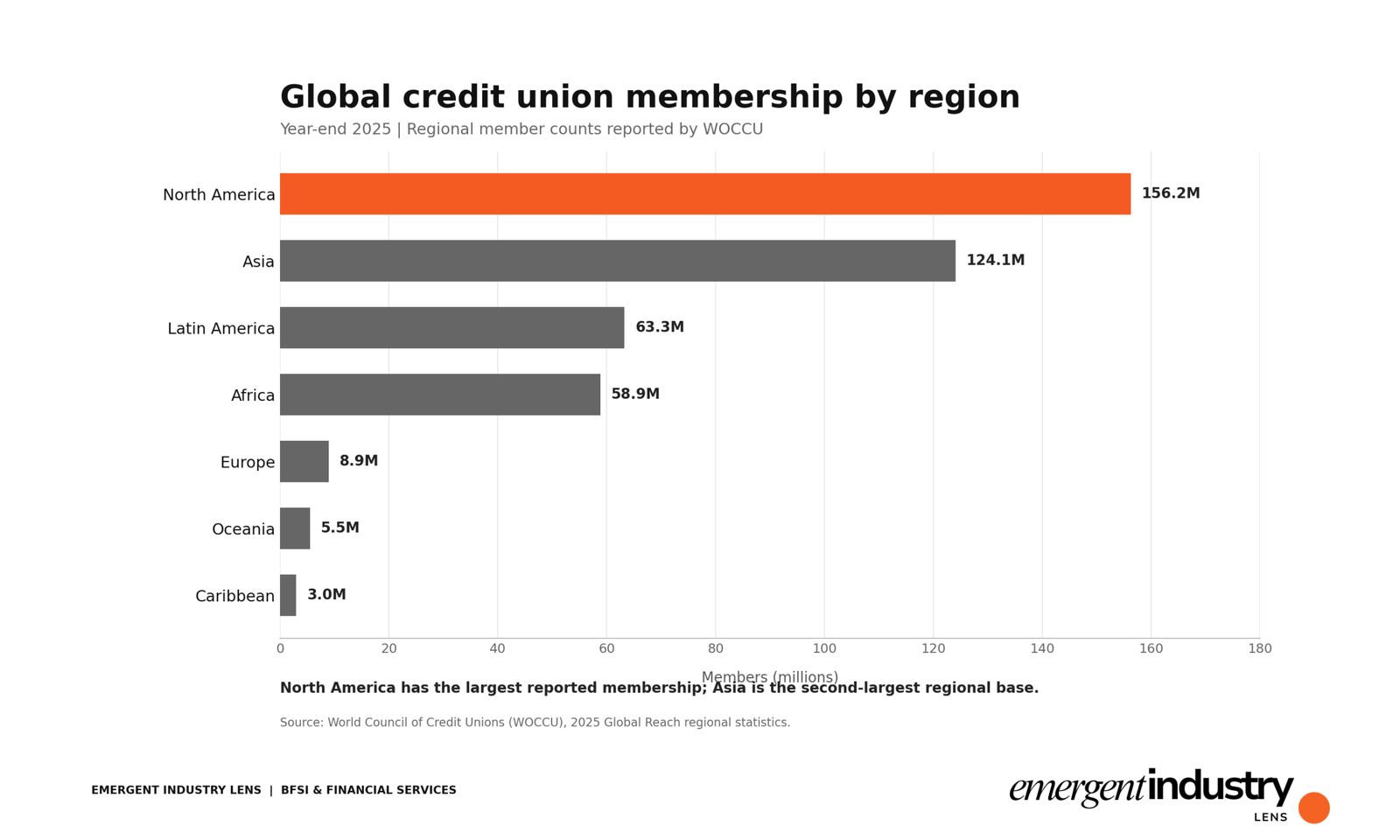
According to the World Council of Credit Unions (WOCCU), the global movement comprised approximately 61,838 credit unions and financial cooperatives across 93 countries at the end of 2025. These institutions served nearly 420 million members, held US$3.98 trillion in assets and reported US$2.83 trillion in loans.
The numbers establish scale, but not necessarily competitive displacement. Commercial banks and credit unions operate under different ownership structures, regulatory regimes and market conditions. Their aggregate assets cannot be compared as if they were interchangeable businesses, and the global figures alone do not establish that credit unions are taking market share from banks.
The more important question is what this scale makes possible and what it still prevents.
Credit unions have historically competed through member relationships, savings and lending propositions, local knowledge and a cooperative ownership model. Yet the economics of modern financial services increasingly reward institutions that can invest continuously in digital platforms, data infrastructure, fraud prevention, compliance and customer acquisition.
This creates the central tension in cooperative finance; the ownership model can differentiate an institution, but it cannot substitute for operational capability.
For banking executives, technology providers and industry strategists, the credit union movement is therefore not simply a story about an alternative to traditional banking. It is a test of whether a different institutional model can achieve the technology, resilience and efficiency required to compete in modern financial services.
Why do customers choose credit unions over commercial banks?
The appeal of credit unions begins with their economic proposition, but it does not end there.
In many markets, credit unions compete through competitive deposit and loan rates, lower or fewer fees on selected products, more personalised service and stronger connections to specific communities or membership groups. Their cooperative structure also changes the relationship between the institution and its customers: eligible members are owners, rather than customers alone.
In a conventional shareholder-owned bank, strategic decisions ultimately operate within a framework that includes shareholder returns. In a member-owned credit union, the institutional purpose is generally centred on serving members, subject to its legal obligations, financial sustainability and governance framework.
That distinction can influence product pricing, service priorities and the allocation of surplus. It does not mean every credit union offers better rates or lower fees than every bank. The outcome depends on the institution, its cost base, funding position, product mix and local competitive environment.
There is also an important trust dimension. Customers may value being treated as members rather than account numbers, particularly when they need advice, borrowing support or help navigating financial difficulty. In underserved communities, cooperative institutions can also provide access to savings, credit and financial services where conventional providers have limited reach.
However, trust is not an unconditional competitive advantage. It must be reinforced through reliable service, transparent pricing, convenient access and the protection of member funds and data.
The 2026 JD Power U.S. Credit Union Satisfaction Study illustrates both sides of this proposition. U.S. credit unions scored 725 out of 1,000 for overall member satisfaction, compared with 657 for U.S. retail banks. Yet credit union satisfaction declined four points year over year, while the study identified growing account attrition and a tendency for consumers to spread their banking relationships across multiple institutions.
This is a critical distinction for executives. High satisfaction does not automatically translate into primary-bank status, greater share of wallet or durable loyalty.
Members can value a credit union while keeping their salary account, credit card, mortgage or digital payments relationship elsewhere. Credit unions must therefore compete not only for membership, but for a larger role in members’ financial lives.
Is the credit union model growing or consolidating into fewer, larger institutions?
The answer is more complicated than a headline growth figure suggests.
WOCCU’s global statistics show that reported membership rose from approximately 412.7 million in 2024 to 419.9 million in 2025, while the reported number of institutions declined from 67,137 to 61,838. However, the latest report also reflects changes in data coverage and methodology. These figures should not be treated as a clean, like-for-like measure of organic growth or closures across every country.
Even with that qualification, the figures raise an important strategic question: can cooperative finance expand its reach while the institutional landscape becomes more concentrated?
North America provides a useful case study of this tension. In its July 2026 analysis of U.S. and Canadian credit unions, S&P Global Market Intelligence reported that the number of federally insured U.S. credit unions had fallen to 4,250 by the first quarter of 2026, from 5,785 a decade earlier. At the same time, their aggregate assets reached US$2.43 trillion at year-end 2025, a 5.4% increase over the previous year.
S&P also reported that U.S. regulators approved 157 credit union mergers in 2025, with the average assets of merging-in institutions rising to US$263 million from US$90 million in 2024.
These figures describe a sector that is consolidating while expanding financially. They do not prove that consolidation alone caused asset growth, but they show why institutional scale has become a central strategic issue.
Mergers can spread the cost of core banking systems, cybersecurity, compliance, data platforms and digital channels across a larger asset and member base. They may also expand geographic reach, product capability and lending capacity.
Yet consolidation carries trade-offs. Integration can be expensive, legacy systems may be difficult to combine, and a larger institution can become more remote from the communities that gave it a competitive identity. If local decision-making and personal service weaken after a merger, the institution risks sacrificing part of the proposition that differentiated it in the first place.
The strategic test is not simply whether a merger creates a larger balance sheet. It is whether the combined organisation becomes more efficient, resilient and useful to members without diluting its cooperative purpose.
What does consolidation mean for competition with banks?
Credit unions are not limited to merging with one another. In some jurisdictions, they can acquire assets and assume liabilities from banks, subject to applicable legal and regulatory requirements.
These transactions need to be distinguished from ordinary credit union mergers. A merger combines credit union institutions; a purchase-and-assumption transaction can involve a credit union taking over specified bank assets and liabilities without acquiring the bank’s charter. The structure, approvals and permissible activities depend on the jurisdiction and transaction.
Such deals can give a credit union access to new markets, deposits, lending portfolios or capabilities more quickly than organic expansion. They also illustrate how the boundaries between cooperative finance and conventional banking can become more complex.
But acquisition is not a shortcut to competitiveness. The acquiring institution must still manage integration, technology compatibility, operational risk, regulatory obligations and the experience of customers who may be unfamiliar with the cooperative model.
Fintech partnerships add another dimension. A credit union may partner with a specialist provider for payments, identity verification, digital lending, fraud detection or customer engagement without acquiring the provider. In a technology-intensive industry, partnerships can extend capability without requiring every institution to build every system internally.
The wider competitive landscape is therefore not a simple contest between credit unions and Wall Street. It is an ecosystem in which credit unions, banks, fintechs, technology vendors and shared-service providers compete and collaborate across different layers of financial services.
Can credit unions close the technology gap without losing their advantage?
Technology is increasingly central to the competitive question because member expectations are no longer defined only by the quality of a branch interaction.
Customers expect reliable mobile banking, rapid payments, frictionless onboarding, timely fraud alerts, responsive support and lending decisions that do not involve unnecessary delays. These capabilities require more than a mobile application. They depend on core systems, integration architecture, data quality, identity controls, workflow automation and effective risk management.
Large banks can spread technology investment across enormous customer bases and product portfolios. Smaller credit unions may face a different economic equation. The cost of modernisation can be substantial relative to their available resources, while postponing investment can leave them with fragmented systems, manual processes and limited visibility into member behaviour.
This is where shared technology platforms, cooperative service organisations and carefully governed fintech partnerships can matter. Institutions do not necessarily need to own every component of their technology stack, but they need sufficient control over architecture, data, security, service quality and vendor dependencies.
Artificial intelligence creates opportunities in areas such as member-service support, document processing, fraud detection, credit operations and internal knowledge management. It also introduces risks involving inaccurate outputs, privacy, model bias, explainability, third-party exposure and governance.
For credit unions, the strategic question should not be whether they have adopted AI. It should be whether a specific deployment improves a measurable outcome without introducing unacceptable risk. Faster processing, better service resolution, stronger fraud detection or improved operating efficiency are more meaningful measures than the number of AI pilots announced.
The same principle applies to digital transformation more broadly: technology expenditure should be connected to member outcomes, operational resilience and sustainable unit economics.
Why are cybersecurity and regulation strategic issues, not back-office costs?
The more financial activity moves through digital channels and connected platforms, the more important operational resilience becomes.
Credit unions hold sensitive personal and financial data and depend on systems that support deposits, payments, lending and account access. A cyber incident can disrupt services, expose member information, create financial losses and undermine the trust on which the cooperative model relies.
The challenge is particularly significant for institutions that rely on external technology vendors or shared infrastructure. Outsourcing a service does not eliminate the need to understand its risks, assess its controls and prepare for service interruption or compromise.
In the United States, the National Credit Union Administration’s 2026 Cybersecurity and Credit Union System Resilience Report documented 588 cyber incidents reported between May 2025 and April 2026. The incidents included threats such as phishing, ransomware, email compromise and third-party incidents. This is U.S.-specific evidence, not a global estimate of credit union cyber risk.
Regulatory requirements also differ materially across countries. In the United States, the NCUA supervises federally insured credit unions within its remit and establishes requirements relevant to areas such as capital, governance, consumer protection and safety and soundness. Other countries operate under different combinations of national, regional and sector-specific regulatory frameworks.
Despite these differences, credit union leaders generally need to consider the interaction of several disciplines: capital and liquidity management, lending standards, anti-money-laundering controls, consumer protection, audit, data privacy, third-party risk and cybersecurity.
The cost of these obligations can intensify the pressure to consolidate or share services. But scale does not automatically guarantee safety. Larger institutions may have more resources to invest, while also operating more complex environments with broader attack surfaces and more demanding integration challenges.
A credible technology strategy must therefore treat security, resilience and regulatory compliance as design requirements—not features to add after deployment.
What does the $4 trillion opportunity mean for banking technology providers?
For core banking vendors, cloud providers, cybersecurity firms, data and integration specialists, payments companies and AI providers, the credit union sector presents a distinct market opportunity.
The need is not simply for more software. It is for technology that can deliver enterprise-grade capability within the operating constraints of institutions that may not have the scale or resources of major banks.
The most relevant opportunities are likely to be those that solve specific business problems:
- Integration and data architecture: connecting core banking systems, lending platforms, payments, customer relationship management and reporting without creating more silos.
- Digital lending: reducing avoidable manual work while maintaining appropriate underwriting, decision controls and auditability.
- Cybersecurity and resilience: improving identity protection, detection, incident response, vendor oversight and recovery readiness.
- Member experience: enabling consistent service across digital and physical channels, with better insight into member needs and service gaps.
- AI-enabled operations: applying automation to well-defined workflows with measurable benefits and clear accountability.
However, technology vendors should not assume that all credit unions share the same buying criteria. A large, digitally mature institution may prioritise platform modernisation and advanced analytics; a smaller institution may need simpler integration, managed services, predictable costs and limited implementation disruption.
The buying decision will also be shaped by procurement cycles, regulatory expectations, existing vendor contracts, integration complexity and the institution’s capacity to manage change.
For providers, the implication is clear: product positioning must connect technical capabilities to the credit union’s operating model and strategic objectives. A generic claim about digital transformation is less persuasive than a credible explanation of how a solution can improve lending efficiency, strengthen controls, reduce manual reconciliation or deliver a more reliable member experience.
Can credit unions scale without becoming the institutions they were created to challenge?
This is the movement’s defining governance question.
Credit unions are member-owned, but member ownership alone does not guarantee strong accountability, effective oversight or superior outcomes. Governance depends on board capability, transparent decision-making, competent management, internal controls and meaningful member engagement.
In U.S. federal credit unions, for example, members generally elect the board under a one-member, one-vote framework, subject to applicable rules. Other jurisdictions have different governance arrangements. The principle is that cooperative identity must be supported by working governance mechanisms, not merely by a statement of purpose.
As institutions grow, leadership teams face increasingly complex choices about executive oversight, risk appetite, technology investment, mergers, executive incentives and the allocation of financial resources. The larger and more operationally complex the institution becomes, the more important it is that members can understand how decisions are made and how management is held accountable.
The challenge is to combine the discipline required to operate a modern financial institution with the member focus that distinguishes cooperative finance. Scale should improve the institution’s capacity to serve members; it should not become an end in itself.
What should financial services leaders watch next?
Three developments will help determine the direction of cooperative finance.
First, the economics of digital investment. Leaders will need to assess whether technology modernisation produces measurable improvements in cost-to-serve, lending performance, fraud prevention, service quality and member retention. Institutions that cannot fund the necessary capabilities independently may increasingly look to shared infrastructure, partnerships or mergers.
Second, the quality of growth. Rising assets and membership are important, but they are incomplete indicators of competitive strength. Retention, primary-account relationships, deposit stability, lending quality, operating efficiency and member outcomes offer a more informative picture of institutional health.
Third, the balance between scale and identity. Consolidation may strengthen the sector’s ability to invest and compete, but it can also distance institutions from local communities. Boards and executives will need to determine how growth affects member representation, service quality and the institution’s original purpose.
The global picture is not uniform. Credit unions operate within different legal frameworks and economic environments, and the North American experience should not be treated as a template for every market. Nevertheless, the common strategic challenge is recognisable: institutions must modernise while preserving the characteristics that make their model distinctive.
As WOCCU President and CEO Paul Treinen said in the organisation’s 2025 statistical report release, “Our continued relevance will depend on how well we adapt while preserving the trust, member focus and cooperative identity that distinguish our model.”
The verdict: a credible alternative, not yet a replacement for Wall Street
The $4 trillion credit union movement demonstrates that cooperative finance is a substantial component of the global financial system. It does not establish that credit unions are about to displace large commercial banks, whose scale, product breadth, capital-market access and global infrastructure remain formidable advantages.
The more consequential possibility is that credit unions can become stronger competitors in selected markets and customer segments by combining their member-centred model with modern technology, disciplined risk management and greater operational scale.
That outcome is not guaranteed. Consolidation can create capacity, but it can also weaken local identity. Digital investment can improve service, but poorly governed technology can introduce new risks. Member ownership can foster trust, but trust must be earned through consistent performance.
The future of cooperative finance will depend on whether its institutions can solve these tensions—not simply on how large the movement becomes.
For banking leaders, the question is not whether credit unions will replace Wall Street. It is whether a financial model built around members can demonstrate that scale, technological sophistication and institutional purpose do not have to be mutually exclusive.
Frequently asked questions
What is the global credit union movement worth?
At year-end 2025, credit unions and financial cooperatives across 93 countries reported approximately US$3.98 trillion in assets, according to the World Council of Credit Unions. The reported system served nearly 420 million members.
How are credit unions different from commercial banks?
Credit unions are generally cooperative, member-owned financial institutions, while commercial banks may be shareholder-owned or operate under other ownership structures. Their governance, regulatory treatment and product capabilities vary by jurisdiction and institution.
Why are credit unions merging?
Mergers can help institutions achieve greater scale, spread technology and compliance costs, expand markets and strengthen operational capabilities. They also create integration risks and may affect local identity and member experience.
Can credit unions acquire banks?
In some jurisdictions, credit unions may acquire bank assets and assume liabilities through approved transactions. These arrangements are distinct from credit union-to-credit union mergers, and the permissible structure depends on local law and regulatory approval.
What are the biggest strategic challenges for credit unions?
Key challenges include digital transformation, cybersecurity, regulatory compliance, operating efficiency, technology integration, member retention and maintaining effective governance as institutions grow.
What does the growth of credit unions mean for fintech and banking technology companies?
It creates opportunities for providers of core banking technology, integration, cybersecurity, digital lending, payments, data platforms and AI-enabled operations. Successful offerings must address specific operational needs, integration constraints and regulatory obligations rather than rely on generic transformation claims.
Editorial note: Global credit union statistics aggregate institutions operating under different national definitions and regulatory systems. U.S. satisfaction, cybersecurity and merger statistics are identified as jurisdiction-specific evidence and should not be generalised to the entire global movement.
Disclaimer
This article is intended for informational and industry-analysis purposes only. It draws on publicly available information, published reports, industry research and other sources believed to be credible at the time of publication. While reasonable efforts have been made to ensure accuracy, Emergent Industry Lens does not warrant that all information is complete, current or free from error.
Market figures, estimates, statistics and opinions attributed to third-party sources remain the responsibility of their respective publishers. Data may vary due to differences in definitions, reporting periods, methodologies and geographic coverage. Interpretations and conclusions presented in this article reflect editorial analysis and should not be construed as definitive predictions of market performance or future developments.
This article does not constitute financial, investment, legal, regulatory or professional advice, nor does it constitute an endorsement or recommendation of any particular institution, product, service or investment. Readers should independently verify material information and consult appropriate professionals before making decisions.
Emergent Industry Lens aims to maintain editorial independence and welcomes corrections or clarifications where credible evidence indicates that published information requires revision.