
An AI company predicted a Novartis drug trial would fail and the trial subsequently missed its primary endpoint. But the same AI got another prediction wrong. With Swiss biotech Atlas Bio raising $12.5 million to simulate human biology, can virtual patients help pharmaceutical companies make better decisions before millions are spent on clinical trials?
By EI Lens | Life Sciences & Digital Transformation
When AI predicted a drug trial failure and got it right
On 26 July 2026, an AI company made a prediction about an experimental Novartis drug. The forecast was not particularly encouraging. The treatment was unlikely to demonstrate statistically significant clinical benefit in its Phase III trial.
The drug was del-desiran, being investigated for myotonic dystrophy type 1, a genetic disorder that can affect muscles and other body systems. The trial, known as HARBOR, was approaching a crucial milestone in the drug’s development.
On 8 September, Novartis announced that the trial had failed to meet its primary endpoint.
The prediction made by BioinvestGPT, a company developing AI-based virtual clinical trial technology, had anticipated the outcome more than six weeks before the results were announced. The prediction and subsequent trial result were reported by Reuters on 7 October 2026.
The market reaction illustrated the financial stakes. Reuters reported that the setback contributed to a sharp fall in Novartis shares and an estimated $30 billion decline in the company’s market value. This was a change in market capitalisation, not a direct measure of the trial’s cost or a loss caused by AI.
For pharmaceutical companies, however, the question was compelling. What if a reliable prediction could flag a potential failure before a company committed years of work and substantial resources to a clinical programme?
Could AI help drug developers recognise a weak candidate earlier, reconsider a patient population or redirect investment towards a treatment with better prospects?
It is an enticing possibility. But this story has a twist.
The same AI got another Novartis prediction wrong
BioinvestGPT also predicted a positive outcome for another Novartis programme, pelacarsen, an experimental treatment designed to lower lipoprotein(a), or Lp(a), a blood particle associated with cardiovascular risk.
The Phase III HORIZON trial subsequently failed to demonstrate a reduction in major cardiovascular events, despite lowering Lp(a) levels.
According to Reuters’ investigation into AI-based virtual drug trials, BioinvestGPT’s co-founder acknowledged that the model had failed to account adequately for genetically determined variations in Lp(a) size.
The distinction is important. A drug can affect its intended biological target without delivering the clinical outcome that matters to patients.
In other words, getting the biology partly right does not necessarily mean predicting the clinical outcome correctly.
The two Novartis examples tell a more revealing story together than either does alone. One prediction aligned with a subsequent trial failure; another did not. They illustrate both the promise of AI-based prediction and the difficulty of modelling the complex interactions that determine whether a medicine works in humans.
For an industry where late-stage setbacks can have substantial scientific and commercial consequences, even the possibility of improving predictions is attracting attention.
And investors are beginning to place bets on the technology.
Atlas Bio raises $12.5 million to simulate human biology
On 27 October 2026, Swiss biotech startup Atlas Bio announced $12.5 million in funding to develop AI models that simulate human biology and predict drug responses.
The announcement, covered by Reuters and Tech.eu, adds to the growing interest in computational approaches to drug development.
According to the reports, Atlas Bio is developing a foundation model trained on approximately two million RNA readouts from human tissue. RNA readouts provide information about gene expression, i.e., how genes are transcribed into RNA under particular biological conditions.
The company says its platform can simulate drug responses in virtual patients, with projects potentially taking around 12 weeks. Its ambition is to help pharmaceutical developers evaluate treatment responses and explore development options earlier in the research process.
Why does that matter?
A medicine may show promise in early experiments but fail later because its effects in humans are more complicated than expected. A computational model that can reliably identify likely failures, suggest more suitable patient populations or highlight promising alternative indications could help researchers make better-informed decisions before committing to expensive trials.
Atlas Bio’s funding is a sign of commercial interest in that possibility. It is not, by itself, proof that the platform can accurately predict clinical outcomes. The company’s reported capabilities and timelines still need to be assessed against independent evidence.
To understand what these companies are attempting to achieve, we need to look at the science behind the idea.
What Are ‘In Silico Clinical Trials’?
Drug development has traditionally relied on laboratory experiments, preclinical research and clinical trials involving human participants. Each stage provides essential evidence, but each also takes time and may leave important questions unanswered.
Could a treatment work differently in one patient group than another? Is a particular biological mechanism likely to produce a meaningful clinical benefit? Would a different trial design help researchers identify the patients most likely to respond?
These are some of the questions that computational models are being developed to investigate.
An ‘in silico clinical trial’ uses computer-based models to simulate aspects of a drug’s effects, patient responses or clinical trial outcomes. The term in silico refers to research performed using computational models or computer simulations.
Depending on the technology, these models may draw on molecular and genetic information, gene-expression data, biological measurements, previous clinical trial results and published research. They use this evidence to estimate how a treatment might perform under specified conditions.
The objective is not necessarily to recreate every detail of a living human body. It is to build a model that can help answer a defined scientific or development question.
For example, a model might help researchers compare potential patient groups, investigate whether a drug’s mechanism is promising or estimate the likelihood of achieving a particular endpoint. The usefulness of the result depends on how well the model represents the relevant biology and how thoroughly its predictions have been validated.
In silico trials vs virtual clinical trials, what is the difference?
The terminology can be confusing because several different technologies are being discussed under the broader umbrella of digital clinical research.
- In silico clinical trials use computational models to simulate aspects of biological responses, drug effects or clinical outcomes.
- Virtual or decentralised clinical trials involve real participants who may take part remotely through telemedicine, digital monitoring, home visits or other technology-enabled processes.
- AI-assisted clinical recruitment uses AI to identify people who may qualify for a real clinical trial, often by analysing electronic medical records.
These approaches can complement one another, but they are not interchangeable. An AI system that identifies eligible patients has not necessarily demonstrated that it can predict drug efficacy. Likewise, a simulation that predicts an outcome correctly does not establish that a medicine is safe and effective.
That distinction becomes especially important when evaluating claims that AI could reduce the need for conventional clinical testing.
A real-world simulation that got the direction right, but overestimated the benefit
The challenge of modelling human biology did not begin with today’s generative AI boom. Researchers have been developing computational models of disease and treatment response for years, with mixed results.
A useful example appears in a 2022 peer-reviewed study published in Annals of Biomedical Engineering: “Accelerating Digitalization in Healthcare with the InSilicoTrials Cloud-Based Platform: Four Use Cases”.
One of the study’s use cases involved modelling natalizumab treatment for multiple sclerosis. Researchers compared the model’s estimates of the proportion of patients who would remain relapse-free over 104 weeks with observed trial results.
For the control group, the model estimated that approximately 40% of patients would remain relapse-free, close to the observed result of 41%.
For the treatment group, however, the model predicted a relapse-free proportion above 90%, while the observed result was 67%.
The simulation captured an important part of the picture but substantially overestimated the magnitude of the treatment outcome.
This is a crucial lesson for AI-powered clinical development. A model can identify the general direction of a treatment effect and still be insufficiently accurate for decisions that depend on the size of the benefit, the risks involved or the likelihood of achieving a clinical endpoint.
Patient history, previous treatments, treatment resistance and biological variability can all complicate predictions. A credible model must therefore be evaluated not only on whether it gets the direction right, but also on how closely its estimates match observed outcomes.
AI is also helping researchers find patients for real clinical trials
While some companies are developing virtual patients to simulate treatment responses, others are using AI to improve the recruitment of real participants.
In March 2026, Cleveland Clinic reported findings from an AI-assisted clinical recruitment study.
The study used Dyania Health‘s Synapsis AI platform to screen electronic medical records for people who might qualify for a Phase III trial involving transthyretin amyloid cardiomyopathy, a form of heart failure.
In one week, the system screened 1,476 patient records and identified 46 potential matches. Following review, 30 were considered matches; 29 had not been identified through traditional screening.
Seven patients enrolled through AI-assisted screening in six days, compared with 10 patients enrolled through traditional screening over 90 days at the site. The researchers also reported that the AI-assisted process identified a more diverse group of potential participants.
This example shows how AI can help researchers find eligible participants more efficiently and potentially reach people who might otherwise be overlooked.
It does not demonstrate that AI can predict whether a drug will succeed. The system helped identify real people for a real trial; it did not simulate their biological responses.
Together, AI-assisted recruitment and in silico clinical trials could address two different challenges, finding the right people for a study and making better-informed decisions about which studies to conduct.
How do AI virtual patient models work?
Although individual platforms differ, AI-based in silico clinical trials generally involve several steps.
1. Define the question. Researchers specify the drug, disease, patient population, comparator, clinical endpoint and timeframe. A prediction is meaningful only in relation to a clearly defined question.
2. Assemble the evidence. Depending on the platform, inputs may include molecular and genetic information, biological measurements, prior clinical trial results, published research and disease models.
3. Build or select the model. Machine-learning systems, mechanistic models or combinations of both are used to represent relevant aspects of drug action and disease biology.
4. Simulate possible responses. The system estimates outcomes under specified conditions. Researchers may compare different treatments, patient subgroups or development strategies.
5. Validate the predictions. The predictions are compared with independent evidence, including observed clinical outcomes where available. Prospective predictions—made before the results are known—are particularly valuable for assessing predictive performance.
6. Apply the findings to decisions. Depending on the strength of the evidence, the model may help researchers prioritise candidates, refine trial design, explore alternative indications or identify questions requiring further investigation.
This process does not eliminate uncertainty. The value of a simulation depends on data quality, model assumptions, biological complexity and the particular decision it is intended to support.
From biological data to clinical insight
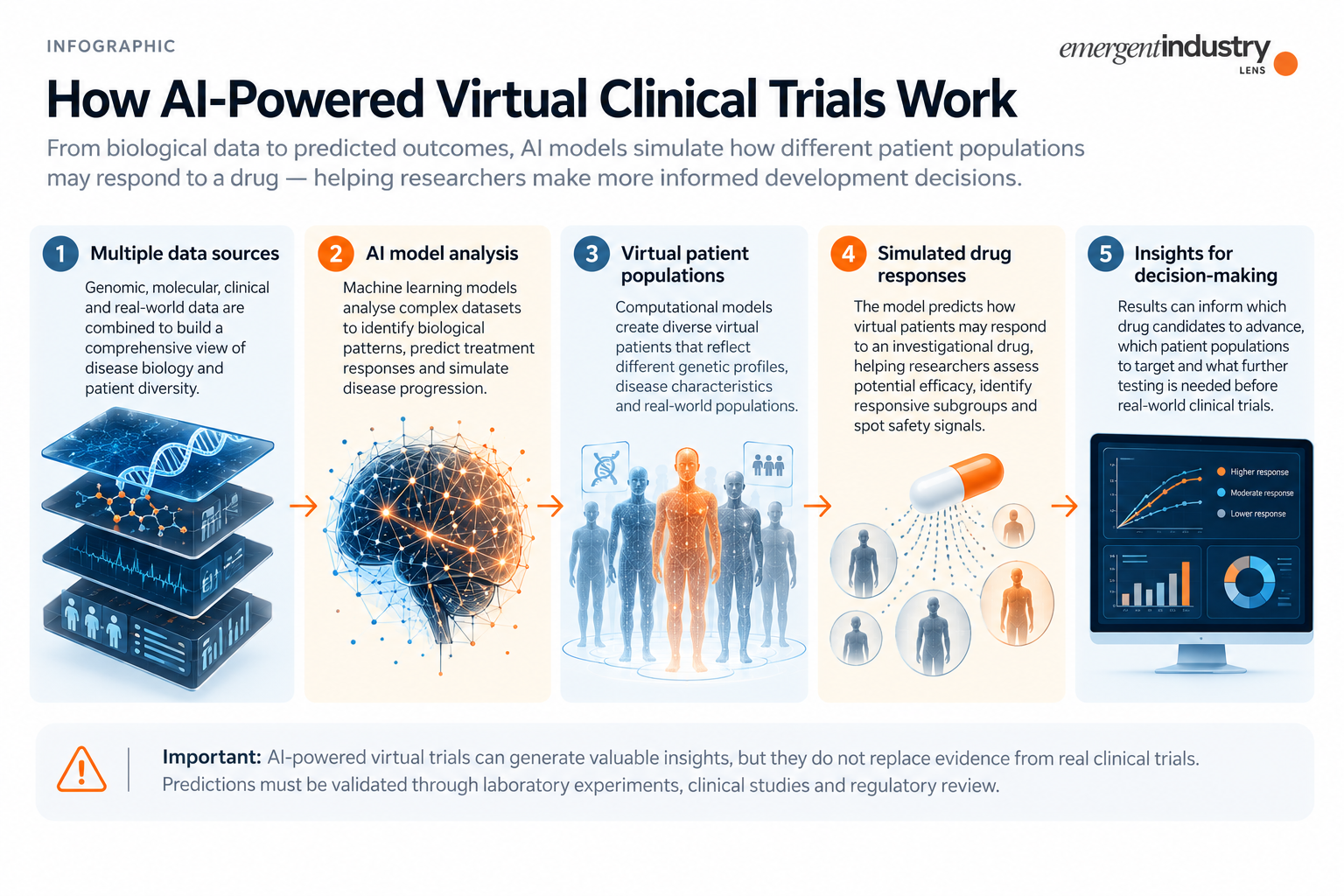
How can AI help researchers assess a drug before it enters a clinical trial? The process begins with biological and clinical data, which computational models analyse to simulate potential treatment responses across virtual patient populations.
These predictions may help researchers identify promising candidates, explore patient subgroups and prioritise further investigation. The following infographic illustrates the concept and why simulated outcomes must still be validated against real-world clinical evidence.
Can in silico clinical trials replace human trials?
Not on the strength of current evidence alone.
AI simulations may help researchers prioritise candidates, investigate alternative development strategies and identify potential problems earlier. In some circumstances, computational evidence may contribute to a broader evidence package supporting regulatory or development decisions.
However, a virtual patient is a model—not a person whose full biology, medical history and response to treatment have been observed.
A simulation may fail to capture an unexpected adverse effect, an interaction between biological pathways or differences between the population represented in its data and the people who ultimately receive the medicine. Models can also reproduce biases and limitations present in their training data.
Regulatory expectations are therefore critical. In January 2026, the US Food and Drug Administration (FDA) and European Medicines Agency (EMA) published joint guiding principles for good AI practice in drug development.
The principles address human-centred design, risk-based assessment, data governance, model development, performance evaluation, documentation and lifecycle management. They provide a framework for responsible AI use in drug development; they are not blanket approval for every simulation platform or intended use.
For pharmaceutical companies, the question is not simply whether a model can produce a convincing prediction. It is whether the model has been validated for its intended purpose, whether its limitations are understood and whether the evidence is strong enough to support the decision.
Five questions pharma should ask before trusting AI simulations
As AI-based clinical development tools mature, pharmaceutical and biotech teams will need to evaluate them with the same rigour applied to other evidence used in drug development.
1. Has the model been tested prospectively?
A record of predictions made before clinical results become public is more informative than examples selected retrospectively after the outcome is known.
2. Does it predict the right endpoint?
Predicting a molecular change or biomarker response is not equivalent to predicting a clinically meaningful improvement in patients.
3. Does it work across different populations and diseases?
A model’s performance in one therapeutic area cannot automatically be generalised to another. Validation should reflect the intended population and application.
4. Are uncertainty and failure cases disclosed?
Companies should examine false-positive predictions, false negatives, calibration and the conditions under which the model performs poorly—not just headline accuracy figures.
5. Can the results be independently evaluated?
Documented assumptions, clear data sources, a defined intended use and independent evaluation help researchers assess whether a prediction should influence an expensive development decision.
These questions are particularly important when a company claims that its simulations can replace a stage of testing. Such claims require evidence specific to the proposed application, rather than a strong general performance statistic alone.
What pharma must learn from the AI prediction race
The first wave of AI in life sciences focused heavily on identifying drug targets, designing molecules and accelerating early-stage discovery. The next wave is increasingly concerned with what happens after a candidate has been identified: which patients might benefit, which indication is most promising and whether a clinical programme is worth pursuing.
Companies such as Atlas Bio, QuantHealth and BioinvestGPT are pursuing approaches to AI-driven clinical development and trial simulation. Their methods, claims and validation records should be evaluated individually rather than assumed to be equivalent.
Atlas Bio’s funding announcement is a timely signal that investors see an opportunity to bring AI deeper into clinical development. The Novartis examples, meanwhile, demonstrate why the opportunity cannot be judged by successful predictions alone.
The technology will be most useful if it helps researchers make better decisions earlier without obscuring uncertainty or creating false confidence. That could mean identifying a likely failure, discovering a more suitable patient population, refining a trial protocol or deciding that a candidate needs more evidence before progressing.
For now, the strongest case for in silico clinical trials is not that computers can make human trials obsolete. It is that better computational evidence may help drug developers decide which questions to ask, which experiments to run and where the next investment is most justified.
The real test will be whether these virtual predictions repeatedly hold up when confronted with human biology.