

A sharp rise in global bond yields is creating new risks for Asian lenders. As HSBC, Standard Chartered and DBS prepare to report earnings, investors are assessing whether market volatility could weaken bank capital, squeeze profitability and affect shareholder returns. India is already experiencing the effects of foreign investors retreating from regional bond markets.
By Emergent Industry Lens | Banking & Financial Services | 26 October 2026
The big story: Why are Asian banks under pressure?
Asian banks are facing a financial stress test as rising government bond yields, persistent inflation and currency volatility threaten to increase funding costs and reduce the value of certain investments.
The immediate trigger was a sharp global bond-market sell-off in early October. The yield on the US 10-year treasury briefly reached 5.34%, its highest level in more than two decades, before easing to around 5.11%. Japanese government bond yields also rose, adding pressure on financial institutions with significant holdings of longer-duration securities.
The developments have raised concerns about three interconnected risks; potential losses on bond portfolios, pressure on regulatory capital and higher funding costs.
According to a Reuters report published on 26 October 2026, analysts are examining how these pressures could affect the earnings outlook for major Asia-focused lenders, including HSBC, Standard Chartered and Singapore’s DBS Group.
This is not evidence that Asia’s banking system is facing an imminent crisis. Many major lenders have established deposit franchises and continue to generate substantial earnings. The concern is whether a prolonged period of high yields and expensive funding could gradually erode the financial buffers that allow banks to lend, absorb losses and distribute dividends.
The distinction matters. A temporary fall in bond prices is manageable for many institutions, but persistent market pressure combined with weaker earnings and deteriorating credit quality can become a more serious problem.
1. What happens when bond yields rise?
To understand the risks facing banks, it helps to understand the relationship between bond prices and interest rates.
When market yields rise, the price of an existing fixed-rate bond generally falls. Investors can obtain better returns from newly issued bonds, making older securities with lower fixed coupons less attractive.
Banks hold government and other fixed-income securities for investment, liquidity management and regulatory purposes. When those securities lose market value, the consequences depend on how the investments are classified, the duration of the portfolio and the institution’s hedging arrangements.
Three effects are particularly important.
First, investment portfolios can lose value. Some valuation losses can affect reported equity or regulatory capital, depending on accounting and capital rules.
Second, funding can become more expensive. Banks may have to offer more attractive deposit rates or pay more to borrow in wholesale markets. If the cost of funding rises faster than income from loans and investments, profit margins can narrow.
Third, capital flexibility can decline. If valuation losses and weaker earnings reduce capital buffers, banks may have less room to expand lending, absorb future shocks or return capital to shareholders.
However, higher interest rates can also benefit banks by improving returns on new loans and reinvested assets. The net impact depends on how quickly assets and liabilities reprice and how effectively each institution manages its balance sheet.
2. What do the earnings forecasts tell us about HSBC, Standard Chartered and DBS?
The immediate test for investors is whether the three major lenders can deliver earnings in line with expectations while managing the market pressures.
Reuters reported the following analyst forecasts ahead of their third-quarter results for July–September 2026.
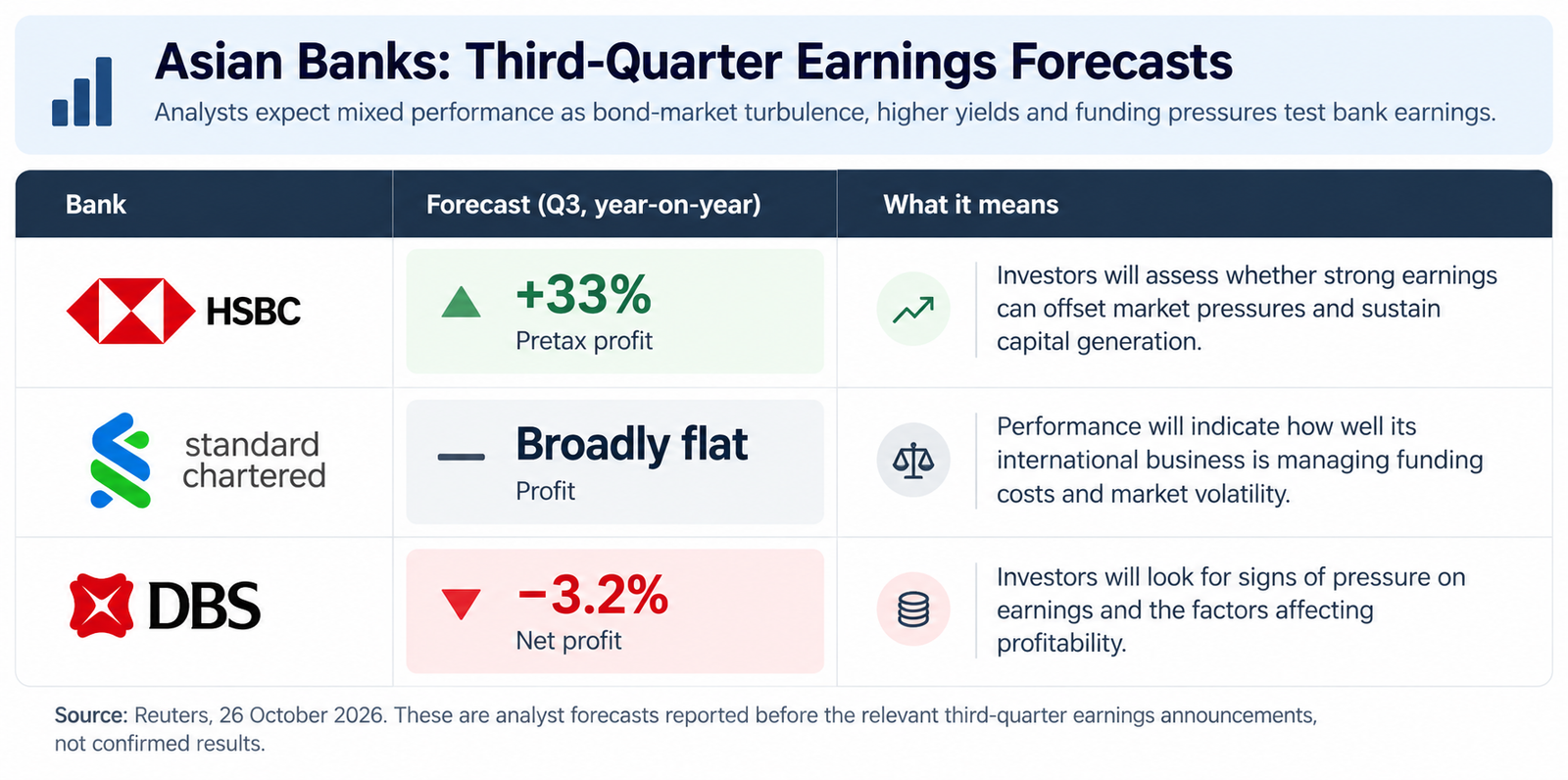
The contrast is important. A bank can report strong earnings while still facing pressure on the value of its investments or the cost of its funding. Conversely, a modest decline in quarterly profit does not automatically indicate a deterioration in financial stability.
Investors will therefore be looking beyond headline numbers to examine net interest margins, capital ratios, liquidity, credit provisions and management guidance.
The results should also help clarify whether the market’s concerns are temporary or whether banks expect funding and valuation pressures to persist into subsequent quarters.
3. Why are bank shareholders concerned about dividends?
One of the most tangible implications of the bond-market sell-off is its potential effect on shareholder returns.
Banks distribute dividends from the financial resources available to them after accounting for earnings, capital requirements and other obligations. If investment losses affect capital ratios, or if profitability weakens, management may have less flexibility to maintain or increase distributions.
Morningstar equity analyst Kathy Chan, quoted by Reuters, highlighted the potential for pressure on banks’ capital ratios and dividend payouts. She also noted that strong earnings can help mitigate the impact by generating capital internally.
This creates an important distinction for investors.
A bank with robust recurring earnings may be able to absorb valuation losses while maintaining a healthy capital position. An institution with weaker earnings, greater exposure to long-duration assets or more expensive funding could have less flexibility.
The implications extend beyond dividend income. Investors may also reassess bank valuations if they believe earnings growth, capital returns or future lending capacity could be constrained.
However, the Reuters report does not establish that the named banks have announced dividend cuts. The concern is a potential consequence of prolonged market pressure, not a confirmed outcome.
4. Who are the experts raising the alarm?
The Reuters report draws on analysts who examine the financial sector from different perspectives.
Harsh Wardhan Modi — JPMorgan
Modi, co-head of Asia-Pacific financials and head of ASEAN research at JPMorgan, identified three channels through which rising yields can affect banks: liquidity, capital and profit and loss. His analysis focuses on how market movements can flow through balance sheets and ultimately influence earnings expectations.
Kathy Chan — Morningstar
Chan’s analysis highlights the connection between bond valuations, capital ratios and dividends. Her assessment also recognises that earnings generated by the banks themselves can help offset market-related losses.
Alka Anbarasu — Moody’s Ratings
Anbarasu, an associate managing director in Moody’s financial institutions group, warned of further upward pressure on Japanese interest rates. This is particularly relevant for lenders with long-duration assets, which can experience substantial unrealised losses when yields rise.
Sally Yim — Moody’s Ratings
Yim highlighted another regional risk: tighter Chinese scrutiny of offshore tax compliance could temporarily slow some wealth-related capital flows into Singaporean lenders and international banks. She nevertheless maintained that the longer-term wealth-management growth opportunity remained intact.
These are analysts’ assessments of risks and potential outcomes. They should not be confused with official forecasts from the banks themselves or regulatory declarations that institutions are in financial distress.
5. Japan and Southeast Asia: Where could the risks be greatest?
The impact of rising yields differs across Asia because banks have different investment portfolios, funding structures and exposure to foreign currencies.
Japan: Unrealised losses on long-term investments
Japanese government bond yields have risen, creating valuation pressure for institutions holding longer-duration securities.
Moody’s has warned about losses affecting selected lenders, including Norinchukin Bank and Japan Post Bank. The underlying issue is the sensitivity of long-duration assets to changing interest rates.
An unrealised loss does not necessarily mean that a bank has suffered an immediate cash loss. However, if liquidity needs force a sale of securities at depressed prices, losses can become realised. The implications depend on the bank’s funding position, accounting treatment and ability to hold the investments.
Southeast Asia: Inflation and currency volatility
In markets such as Indonesia and the Philippines, inflation and exchange-rate movements can create additional challenges.
When a local currency weakens, borrowers with foreign-currency debt may face higher repayment costs if their liabilities are not adequately hedged. This can increase credit risk for banks.
Meanwhile, higher wholesale funding costs can place pressure on lenders that depend more heavily on market-based financing.
The risks are therefore not identical across the region. The key questions are how much exposure each institution has, whether its borrowers can withstand higher costs and whether sufficient capital and liquidity buffers are available.
6. India: What do foreign bond outflows mean for the banking sector?
India provides a concrete example of how global financial conditions can affect regional markets.
In a separate report published on 16 October 2026, Reuters reported that foreign investors sold a net US$8.21 billion of bonds across five Asian markets in September: India, Indonesia, Malaysia, South Korea and Thailand. The withdrawal was the largest monthly net outflow from those markets since March 2020.
India accounted for US$548 million of the bond outflows.
The report linked the broader retreat to rising US Treasury yields, renewed Federal Reserve tightening and reduced investor appetite for emerging-market debt.
Read the Reuters report on Asian bond outflows.
Why would foreign investors sell Indian bonds?
International investors compare returns across markets, taking account of interest rates, currency movements, liquidity and risk.
When US government bonds offer higher yields, they can become more attractive relative to emerging-market debt. Investors may reduce exposure to markets such as India, especially when currency uncertainty or expectations of tighter monetary policy increase.
Foreign selling can put downward pressure on bond prices and upward pressure on yields, although the actual effect depends on domestic demand, government borrowing and central bank operations.
This does not mean that Indian banks automatically incur losses of the same magnitude. The impact depends on their holdings, accounting classifications, funding structures and broader balance-sheet positions.
What does this mean for Indian banks?
Three issues deserve attention.
- Government bond portfolios: Changes in yields can affect the market value of securities held by banks, depending on how those holdings are classified and managed.
- Funding and liquidity: Domestic monetary conditions, deposit mobilisation and money-market rates influence the cost and availability of funds.
- Credit quality: If tighter financial conditions eventually affect businesses and households, banks may face additional pressure on loan repayments and provisions.
India’s banking story is therefore related to, but not identical to, the pressures facing Singapore’s internationally exposed lenders.
For India, the next step is to examine current government bond yields, foreign portfolio flows, RBI liquidity conditions and individual banks’ reported exposures before drawing conclusions about the severity of the impact.
7. What is the outlook for Asian banks?
The outlook depends substantially on whether the bond-market turbulence proves temporary or becomes a more persistent feature of the financial environment.
Three scenarios illustrate the potential consequences.
Scenario 1: Bond yields stabilise. If yields ease and market conditions settle, some valuation pressures could diminish. Banks with healthy earnings and stable funding would have more time to manage their balance sheets.
Scenario 2: Yields remain elevated. Banks could continue to face expensive funding, pressure on certain investment portfolios and greater scrutiny of capital ratios. Investors may become more selective about earnings quality and dividend sustainability.
Scenario 3: Higher yields coincide with weaker economic conditions. If inflation and borrowing costs begin to impair borrowers’ repayment capacity, valuation pressures could be compounded by rising credit losses. This would create a more difficult environment for banks with concentrated exposures or limited financial flexibility.
These are analytical scenarios, not predictions that any particular outcome is inevitable.
The direction of US monetary policy, Japanese interest rates, inflation and currency movements will be important variables to monitor. Domestic conditions will also matter: strong deposits, sound underwriting and diversified earnings can help banks absorb external shocks.
For investors, the coming earnings announcements should provide additional evidence about how individual institutions are positioned.
8. What should banking leaders and technology providers do with this information?
The implications extend beyond bank treasurers and equity investors.
When markets become volatile, institutions need timely information about investment positions, liquidity, funding costs and borrower exposures. Fragmented data can make it difficult to understand the combined effect of changing yields and deteriorating market conditions.
This creates practical priorities for banking leaders:
- Improve visibility across treasury, finance and risk-management data.
- Strengthen stress testing for interest-rate, currency and liquidity scenarios.
- Monitor deposit concentration and funding costs more closely.
- Integrate credit-risk information with customer and financial data.
- Use analytics and automation to identify emerging risks and improve reporting.
For technology providers, this may create opportunities in treasury modernisation, financial data integration, risk analytics, regulatory reporting and cybersecurity.
The commercial opportunity should not be overstated. Market turbulence does not automatically translate into increased technology spending. Banks will prioritise investments according to regulatory obligations, risk exposure, budgets and measurable business benefits.
Nevertheless, the developments reinforce the value of reliable data and integrated risk systems in helping institutions respond to changing conditions.
The bigger picture: A test of resilience, not a prediction of crisis
The latest bond-market turbulence exposes a central challenge for Asian banking: maintaining profitable growth when the value of financial assets, the cost of funding and the strength of borrowers can change simultaneously.
Singapore’s banks must navigate international market exposure and cross-border capital flows. India’s lenders face the interaction between global investor sentiment and domestic funding conditions. Japanese and Southeast Asian institutions have their own sensitivities to interest rates, currencies and portfolio composition.
For investors, the immediate task is to separate market-driven concerns from evidence of deterioration in individual banks’ financial positions.
For banking leaders, it is to ensure that funding, liquidity and capital remain resilient under different scenarios.
For technology providers, it is to understand where institutions need better data, more effective risk monitoring and faster decision-making.
The real story is not simply that bond yields have risen. It is whether Asian banks can absorb the resulting pressures while continuing to lend, generate earnings and return capital to shareholders. The next round of financial results will help show where that resilience is strongest—and where risks require closer attention.
Sources and further reading
- Reuters — Asia-focused banks face capital squeeze due to inflation and bond turbulence, 26 October 2026
- Reuters — Hawkish Fed triggers emerging-market outflows in September, 7 October 2026
- Reserve Bank of India — Monetary policy, banking statistics and financial stability.
- Monetary Authority of Singapore — Banking regulation and financial-sector developments.
- Asian Development Bank — Asia Bond Monitor — Regional bond-market trends.
Editorial note: Forecasts cited in this article reflect analyst expectations reported before the relevant earnings announcements. Verify the latest bank disclosures and market data before publication. The India section draws on a separate Reuters report on regional bond flows; it does not imply that the original bank-risk report identified a specific capital shortfall at Indian banks.
