

From high-performance magnets to AI-powered factories, rare earths have become indispensable to modern manufacturing. As TSMC explores alternatives to rare-earth-dependent equipment, the global industry faces a difficult question. Can it diversify its supply chains before the next disruption?
By Emergent Industry Lens | Manufacturing & Technology
Imagine a semiconductor factory worth billions of dollars. Inside, machines operate with extraordinary precision, producing chips that power smartphones, electric vehicles, defence systems and artificial intelligence infrastructure.
The technology is cutting-edge. The supply chain, however, may depend on something far less glamorous. A small magnet hidden inside a motor.
That is the vulnerability confronting the global manufacturing industry.
On 22 October 2026, Reuters reported that Taiwan Semiconductor Manufacturing Company (TSMC), the world’s largest contract chipmaker, was exploring alternatives to rare-earth components in factory automation equipment. According to people familiar with the matter, the company had surveyed suppliers about using rare-earth-free motors to reduce its exposure to potential Chinese export restrictions. The discussions remain at an early stage; no widespread adoption has been reported.
The development illustrates a growing paradox in manufacturing. The more technologically advanced the factory becomes, the more vulnerable it can be to a disruption in a specialised upstream material.
Rare earths are no longer just a mining story. They are a semiconductor story, an industrial automation story, an energy story and, increasingly, a geopolitical one.
What exactly are rare earths, and why do manufacturers need them?
Rare earth elements are a group of 17 chemically similar metallic elements. Despite their name, they are not necessarily rare in the Earth’s crust. The challenge lies in finding economically viable deposits and separating individual elements from one another, a technically demanding and often environmentally intensive process.
Their value comes from their unusual chemical, optical and magnetic properties.
Neodymium and praseodymium, for example, are important ingredients in powerful permanent magnets. Dysprosium and terbium can improve magnet performance at elevated temperatures. These materials help manufacturers produce motors and generators that are compact, powerful and efficient.
Their applications extend across industrial motors, precision machinery, factory automation, electric vehicles, wind turbines, consumer electronics, aerospace and defence.
The International Energy Agency’s analysis of rare earth elements explains why permanent magnets have become one of the most strategically important applications for these materials.
The critical issue is not simply how much rare-earth material a machine consumes. It is whether the machine can deliver the same performance, reliability and efficiency without it.
A motor may contain only a relatively small quantity of rare-earth material. Yet without the right motor, a highly automated production line may not function as designed.
A relatively small material input can become a critical bottleneck for an enormously valuable manufacturing operation.
A history of demand: From laboratory materials to industrial necessities
The rare-earth story did not begin with electric cars or artificial intelligence. It developed over more than a century, as scientific discoveries created new industrial applications.
The early years: Discovery before mass demand
Rare-earth chemistry developed during the late eighteenth and nineteenth centuries, when scientists began identifying and separating elements from mineral samples. For decades, these materials were largely associated with specialised chemical and scientific applications rather than mass manufacturing.
The discovery of substantial rare-earth deposits at Bayan Obo in China in 1927 later became important to the country’s industrial development. Deposits of ion-adsorption clays in southern China, identified in the 1970s, subsequently provided another source of rare earths, including valuable heavy rare-earth elements.
Demand began changing as electronics, advanced materials and modern industrial technologies evolved.
The 1960s–1980s: High-performance magnets change the market
During much of the twentieth century, the United States was a leading rare-earth producer, supported by operations such as California’s Mountain Pass mine.
Demand expanded as rare earths found applications in catalysts, glass, specialised alloys, phosphors and electronic components. However, the development of high-performance permanent magnets proved particularly consequential.
In 1983, researchers associated with General Motors and Sumitomo Special Metals independently developed neodymium-iron-boron (NdFeB) permanent magnets. These magnets offered exceptional magnetic strength for their size, helping manufacturers design more compact and powerful motors and other devices.
The invention did not create rare-earth demand from scratch. It opened a new chapter in which the materials became increasingly valuable to manufacturers seeking greater efficiency, miniaturisation and performance.
As industrial equipment and electronic products became smaller and more sophisticated, the advantages of powerful permanent magnets became increasingly difficult to ignore.
The 1980s–2000s: China builds an industrial advantage
China’s rise was not simply the result of possessing mineral deposits. It involved decades of industrial development, investment, cost advantages and the expansion of processing and manufacturing capabilities.
According to the Center for Strategic and International Studies’ ChinaPower analysis, China’s rare-earth mining production increased from approximately 8,500 metric tonnes in 1985 to about 48,000 metric tonnes in 1995. Its share of global mining output rose from 21.4% to 60.1% over the same period.
In 1992, Chinese leader Deng Xiaoping famously remarked, as recorded in a UNCTAD report on rare earths: “There is oil in the Middle East; there is rare earth in China.”
The statement captured the strategic importance China attached to these resources.
During the 1990s and 2000s, the country expanded not only mining but also separation, refining, alloy production and magnet manufacturing. Manufacturers elsewhere increasingly faced competition from lower-cost Chinese supply, while processing capabilities and industrial expertise became concentrated in China.
By 2010, China accounted for more than 95% of global rare-earth production, according to the U.S. Geological Survey’s review of China’s rare-earth industry.
The result was a supply chain in which China occupied a dominant position at several stages, from raw materials to finished magnets.
The 2010 warning: When supply security became a geopolitical issue
The first major modern warning came in 2010.
During a diplomatic dispute between China and Japan following the detention of a Chinese fishing-boat captain, rare-earth shipments to Japan were disrupted. At the same time, China reduced export quotas, intensifying concerns among manufacturers that relied on imported materials.
The market reaction was dramatic. Research published in Mineral Economics documents the sharp price escalation and changing Chinese rare-earth policies during this period.
The episode prompted manufacturers and governments to reconsider the risks of relying on a concentrated supply chain. Japan, for instance, supported efforts to develop alternative sources, including investment in Australian rare-earth producer Lynas.
The episode is examined in research on China’s rare-earth policies, 1975–2018 and the CSIS ChinaPower analysis.
The lesson was clear: a mineral that had appeared to be an inexpensive industrial input could suddenly become a strategic vulnerability.
Yet the warning did not immediately produce a fully diversified global industry. Building mines is only one part of the solution. Processing facilities, specialised equipment, technical expertise, environmental approvals and customers willing to support alternative suppliers are equally important.
Why rare-earth demand is accelerating again
Rare-earth demand has entered another growth phase, driven by the convergence of electrification, renewable energy, robotics and digital infrastructure.
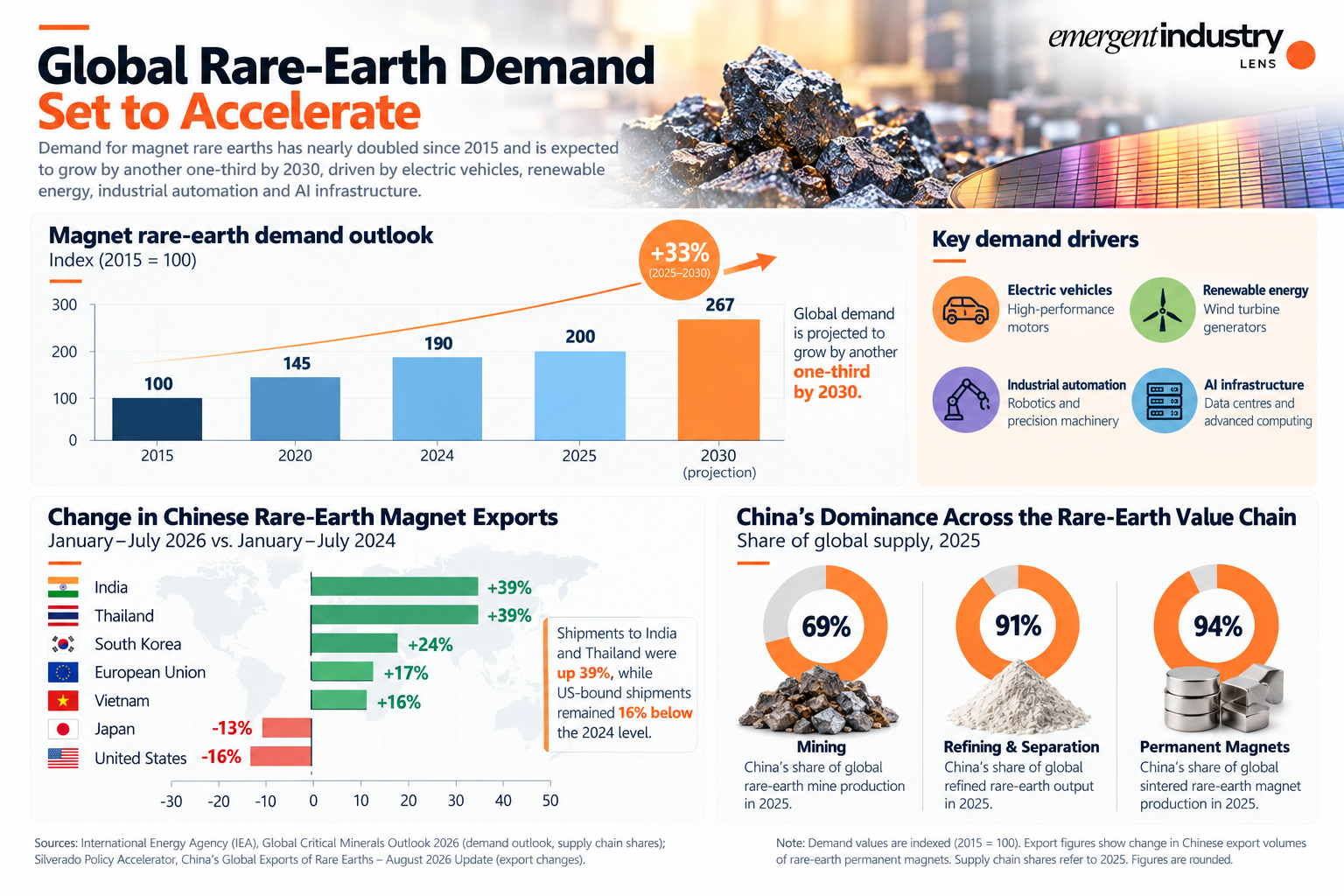
The IEA’s Global Critical Minerals Outlook 2025 documented strong growth in magnet rare-earth demand over the preceding decade. Its subsequent 2026 assessment reinforces the importance of permanent magnets to clean energy, high-tech manufacturing and other strategic industries.
Three forces are particularly important.
1. Electric vehicles and electrification
Permanent magnets enable compact, high-performance motors. As electric-vehicle production expands, manufacturers need reliable supplies of the rare-earth materials used in many traction-motor designs. Alternative motor architectures exist, but switching technologies can involve engineering, performance and cost trade-offs.
2. Renewable energy
Some wind turbines use powerful permanent-magnet generators, particularly in designs where weight, efficiency and reliability are important. As wind-energy capacity expands, demand for the relevant magnet materials can rise.
3. AI infrastructure and factory automation
AI’s influence on rare-earth demand is less direct than its influence on semiconductors or electricity consumption. Nevertheless, the expansion of AI data centres, automated production lines and robotics increases the importance of reliable industrial motors, precision motion systems and advanced equipment.
This third force helps explain why the TSMC development matters. The semiconductor industry is not only a consumer of advanced materials; it also depends on an extensive network of specialised machines whose operation may rely on rare-earth-containing components.
The latest numbers: China’s advantage and the diversification gap
The latest 2026 research provides a clearer picture of where the supply-chain vulnerability lies. The figures below distinguish observed production from planned capacity, since these measure different things.
| Indicator | Latest figure | What it means |
|---|---|---|
| China’s share of global rare-earth mining in 2025 | 69% | China remains the leading source of mined rare earths. |
| Planned mining capacity outside the leading producer by 2035 | Nearly 50,000 tonnes | Announced projects could expand alternative sources of supply. |
| Planned refining and separation capacity outside the leading producer by 2035 | Under 40,000 tonnes | Processing capacity is not keeping pace with mining plans. |
| Planned rare-earth metal, alloy and magnet capacity outside the leading producer by 2035 | About 18,000 tonnes | Downstream manufacturing remains the most significant constraint in the announced project pipeline. |
Sources: UNCTAD, Global Trade Update, June 2026 and IEA, Global Critical Minerals Outlook 2026. The capacity figures are based on announced projects and use the IEA’s stated rare-earth accounting basis; they are not guaranteed future output.
The distinction between mining and processing is crucial.
A country may have rare-earth deposits and still depend on foreign suppliers to separate, refine and convert them into usable materials. Likewise, producing refined rare-earth oxides does not automatically mean that a country can manufacture high-performance magnets at competitive scale.
The IEA’s 2026 outlook identifies this mismatch as a structural weakness in global critical-mineral supply chains.
The numbers also reveal an opportunity. Mining projects are progressing outside China, but the ability to transform raw materials into metals, alloys and finished magnets remains more limited.
In other words, the world’s challenge is no longer just to find more rare earths. It is to build the industrial ecosystem needed to process and use them.
2025–2026: Export controls turn a structural risk into an operational problem
The latest chapter in this story has been shaped by export restrictions.
In April 2025, China introduced export controls covering seven heavy rare-earth elements and related products, including certain compounds, metals and magnets. In October 2025, it announced additional controls involving further elements and processing technologies. The broader October measures were subsequently suspended for one year in November 2025, while the April measures remained in effect, according to the IEA’s 2026 assessment.
These measures demonstrated how quickly a concentrated supply chain can create uncertainty for manufacturers in other countries.
The IEA’s Global Critical Minerals Outlook 2026 estimates that full implementation of the relevant rare-earth export controls could put approximately US$6.5 trillion in annual downstream production outside China at risk. This is an estimate of potentially exposed economic activity, not a forecast of losses that will necessarily occur.
The significance extends well beyond semiconductor fabrication. Automotive production, electronics, energy infrastructure, aerospace and defence all rely on rare-earth-enabled technologies.
For manufacturers, the immediate challenge is not necessarily that every supply of rare earths will disappear. It is that licensing requirements, delays, changing trade rules and price differences can make a critical component difficult to source at the right time, quality and cost.
Why TSMC is looking beyond rare-earth-dependent equipment
TSMC’s reported initiative is a revealing example of how companies are beginning to address the problem at the equipment-design stage.
Instead of relying exclusively on the future availability of rare-earth materials, manufacturers can investigate whether selected motors and other components can be redesigned to use alternative materials or motor architectures.
This is not a simple substitution exercise.
Rare-earth permanent magnets offer a combination of magnetic strength, compactness and performance that is difficult to replicate across all applications. Alternatives may require more space, different cooling arrangements, additional energy consumption or changes to the machinery surrounding the motor.
In semiconductor manufacturing, where equipment operates under stringent precision, reliability and contamination-control requirements, any change must be carefully qualified. A technically feasible alternative may still need extensive testing before it can be deployed in production.
TSMC’s reported discussions therefore represent an early exploration of resilience, not evidence that rare-earth-free semiconductor factories are about to become standard.
The broader principle, however, is significant. Supply-chain resilience increasingly begins with product and equipment design, not merely with procurement.
Can the world diversify its rare-earth supply chains?
Diversification is possible, but it will require sustained investment across several interconnected areas.
1. Develop processing and refining capacity
New mines will have limited impact on dependence if the resulting materials must still be sent to a concentrated processing network. Governments and manufacturers need to support viable separation and refining operations outside existing dominant centres.
2. Expand magnet manufacturing
Manufacturers need reliable access not only to raw materials and refined oxides but also to finished magnets, alloys and specialised components. The gap between planned mining capacity and downstream manufacturing capacity is one of the most important constraints identified by the IEA’s 2026 outlook.
3. Design for substitution
Equipment manufacturers can evaluate alternative motor designs, reduce material intensity where technically possible and qualify multiple suppliers. Substitution will not be practical for every application, but even selective reductions in dependence can improve resilience.
4. Recycle valuable materials
Rare earths contained in end-of-life motors, electronics, electric vehicles and industrial equipment represent a potential secondary supply. However, collection, separation and recovery remain technically challenging, particularly when products contain small quantities of mixed materials.
Recycling is therefore a long-term complement to mining and refining, not an immediate replacement for primary supply.
5. Build international partnerships
No single country needs to replicate every stage of the value chain independently. Strategic partnerships among resource-rich countries, processing specialists, equipment manufacturers and end users can help create more diversified supply networks.
The challenge is to make these alternatives commercially sustainable. New facilities often face higher capital and operating costs than established operations, while customers may be reluctant to pay a premium until a disruption makes the value of resilience obvious.
What this means for global manufacturers
For business leaders, rare-earth exposure should be treated as an operational and strategic risk rather than simply a commodity-price issue.
Manufacturers should identify which products depend on rare-earth magnets, determine where critical components are processed and manufactured, and assess whether alternative suppliers have been technically qualified.
They should also consider the difference between a supplier that has access to raw materials and one that controls a reliable, fully qualified component supply. The two are not necessarily the same.
For semiconductor companies, the risk may sit in factory automation equipment rather than in the silicon wafer itself. For automotive manufacturers, it may be embedded in a motor assembly. For industrial businesses, it could lie several tiers below the supplier with which they have a direct contract.
That makes supply-chain mapping particularly important.
It also creates opportunities for businesses outside China that can build reliable processing, refining, recycling and magnet-manufacturing capabilities.
India, Australia, the United States, Japan and European economies all have reasons to pursue parts of this opportunity, although their capabilities, resource bases and industrial priorities differ. India, in particular, will need to look beyond mineral availability and consider the full ecosystem of processing technology, manufacturing skills, environmental management and customer demand.
The next manufacturing advantage may be resilience
Rare earths illustrate a broader transformation in the economics of manufacturing.
For decades, businesses often prioritised cost efficiency, economies of scale and tightly optimised global sourcing. Those priorities remain important. But geopolitical tensions, export controls and concentrated industrial capabilities have made resilience a more prominent consideration.
The cheapest component is not always the least expensive choice if its supply can be interrupted. Equally, abandoning established suppliers without building technically sound alternatives can increase costs without materially improving security.
The challenge is to strike a balance: retain the benefits of global trade while reducing dependence on critical single points of failure.
TSMC’s reported exploration of rare-earth-free motors is one example of this shift. It does not resolve the global supply-chain problem, but it demonstrates that manufacturers are beginning to question assumptions that once seemed unremarkable.
The history of rare earths offers a useful warning. The 2010 price spike drew global attention to the risks of concentration, yet more than a decade later, mining, processing and magnet manufacturing remain unevenly distributed.
The next phase of industrial competition may therefore depend not only on who can build the most advanced factory, but also on who can keep it operating when a critical material becomes difficult to obtain.
The strategic question is no longer simply where rare earths are mined. It is whether the world can build enough of the processing, manufacturing and technological capability needed to turn them into reliable industrial inputs.
For the global manufacturing industry, that is a challenge worth addressing before the next supply disruption makes it unavoidable.
Editorial disclaimer: This article is intended for industry information and analysis and does not constitute investment advice. Historical figures, current estimates and future capacity projections are distinguished by their reporting periods and source methodologies. Announced projects and scenario-based estimates should not be interpreted as guaranteed future production or realised economic losses.